


How Thick Should a Crib Mattress Be
A full-size crib mattress should be no more than 6 inches thick, and most fall between 4 and 6 inches. In the U.S., that 6-inch limit comes from the federal full-size crib rule (16 CFR part 1219), which requires every full-size crib to carry a warning that the mattress used with it be at least 27 1/4 × 51 1/4 inches and no more than 6 inches thick. See the CPSC Full-Size Baby Cribs FAQ.
The separate federal crib mattress standard (16 CFR part 1241) focuses on fit rather than thickness. A full-size crib mattress must be at least 27 1/4 inches wide and 51 5/8 inches long, and when tested with a pre-shrunk cotton fitted sheet, the gap at the crib corner can't exceed 3.15 inches. See the CPSC crib mattress final rule.
Canada sets the same 15 cm (about 6-inch) limit: under the Cribs, Cradles and Bassinets Regulations (SOR/2016-152), mattresses supplied with a crib can be no more than 15 cm thick, and cribs sold without a mattress must carry a warning to use one no thicker than 15 cm. Cradle and bassinet mattresses are capped at 3.8 cm.
Thickness is only one part of a safe sleep setup. A mattress also needs to be firm and fit the crib snugly, without hazardous gaps.
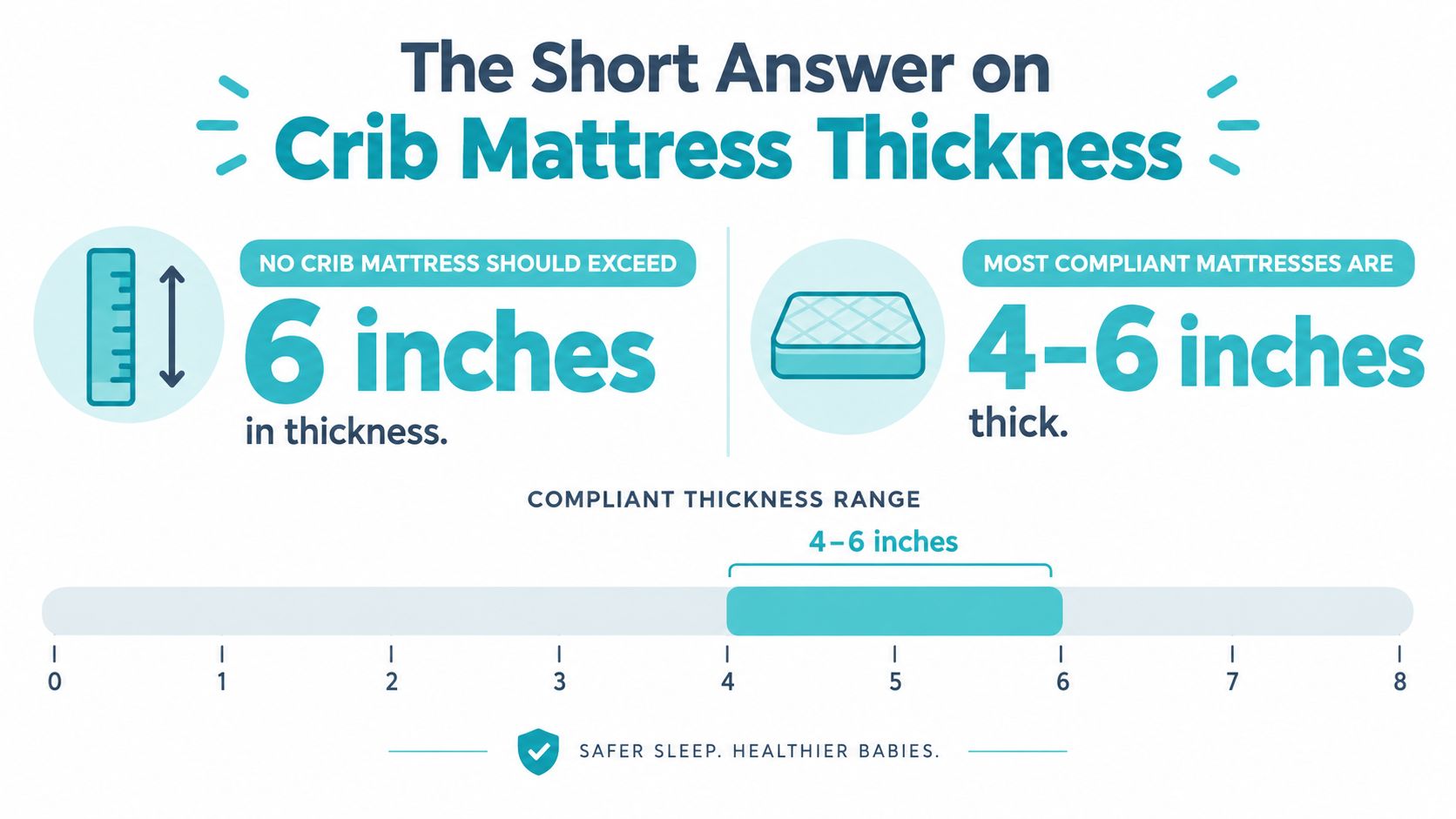
The Short Answer on Crib Mattress Thickness
6 inches maximum, with most full-size crib mattresses between 4 and 6 inches.
Most parents will encounter crib mattresses in that range. Consumer Reports' crib mattress buying guide can provide additional consumer-oriented buying context alongside the federal rules above.
You can also review CPSC's crib mattress business guidance for how the mattress standard fits with related crib requirements.
Thickness is only one check
A mattress can fall within the allowed thickness range and still be a poor choice if it is too soft or does not fit the crib properly. The safety considerations work together:
- Thickness: Stay within the 6-inch limit shown on the crib warning, and follow the manufacturer's compatibility information.
- Firmness: The sleep surface should remain firm and resist excessive compression.
- Fit: The mattress should fit securely against the crib sides and corners without hazardous gaps.
The CPSC identifies mattress firmness, fit, thickness, and floor structure among compatibility factors addressed by the crib mattress requirements.
Why Mattress Thickness Matters
Mattress thickness matters because it affects the geometry of the sleep space. A higher sleep surface reduces the distance between the top of the mattress and the top of the crib side.
The CPSC explains that the crib mattress rule addresses hazards associated with mattress compatibility, including firmness, fit, thickness, and other structural factors. The goal is not simply to make every mattress a particular thickness; it is to help ensure that mattresses work safely with the products for which they are intended.
The measurements work together
For a full-size crib mattress in the U.S., these figures work together:
| Measure | Source | Requirement / note |
|---|---|---|
| Mattress minimum width | 16 CFR part 1241 | 27 1/4 inches |
| Mattress minimum length | 16 CFR part 1241 | 51 5/8 inches |
| Corner gap when tested | 16 CFR part 1241 | No more than 3.15 inches (80 mm) |
| Maximum mattress thickness | 16 CFR part 1219 crib warning | No more than 6 inches |
| Typical retail range | Market practice | About 4–6 inches |
The mattress-size and corner-gap requirements come from the federal crib mattress standard. The 6-inch maximum is the limit parents see on every compliant full-size crib warning under the full-size crib rule.
The CPSC defines a full-size crib by its interior dimensions, which are approximately 28 inches wide × 52 3/8 inches long, within specified tolerances.
These measurements leave little room for an incorrectly sized mattress to shift or leave a hazardous opening. A mattress that is too small can create gaps, while the mattress's height needs to be compatible with the crib and its intended configuration.
The safest approach is to measure the crib's interior and compare those measurements with the manufacturer's specification sheet. Don't rely only on the word “standard.” That label describes a category, not a guarantee that every mattress will fit every crib perfectly.
Firmness Matters as Much as Thickness
A mattress can be within the allowed thickness range and still be inappropriate if it is too soft. Infant sleep guidance emphasizes a firm, flat sleep surface rather than one that allows an infant's head or face to sink deeply into the material.
The CPSC's crib mattress requirements include provisions addressing sleep-surface firmness because excessive softness can contribute to suffocation hazards.
Use your hand before you use the crib
Start with a simple pressure check. Press firmly into the center of the mattress, then release. A suitable infant sleep surface should feel firm rather than plush and should not allow deep, persistent indentation.
Repeat the check near the perimeter. A mattress may feel firm in the middle but respond differently near the edge. That can be worth investigating before using the mattress.
Practical rule: A firm crib mattress should feel supportive, not plush. “Comfortable” for an adult hand isn't the same as appropriate for an infant sleep surface.
The pressure check is a practical observation, not a substitute for the applicable safety standard or a laboratory test. Follow the mattress and crib manufacturer's instructions for use and compatibility.
For a deeper explanation of pressure response and surface support, see Hiccapop's guide on how firm a crib mattress should be.
How to Check the Fit Inside Your Crib
Thickness tells you how tall the mattress is. Fit tells you whether it stays where it belongs. A crib mattress should lie level, sit securely within the crib, and avoid hazardous gaps or movement.
Check the mattress-to-crib gap
Place the mattress in the crib according to the manufacturer's instructions. Check around the perimeter and especially at the corners for visible gaps.
For full-size crib mattresses, the federal crib mattress rule uses a specific 3.15-inch (80 mm) maximum corner-gap test with a test mattress sheet. That is the laboratory measurement used for compliance.
At home, many parents still use a simple two-finger check as a quick screen: if you can fit more than about two fingers between the mattress and the crib side, the gap may be too large and you should stop and compare the mattress and crib specifications. The two-finger check is not a substitute for the federal test or the manufacturer's fit instructions, but it is a useful at-home warning sign.
Also make sure the mattress is the correct size for the crib and follows the manufacturer's compatibility instructions.
Look for movement and unevenness
The mattress should remain flat on its support. Push gently near each corner and side. If it shifts, rides upward, or otherwise appears incompatible with the crib, stop and check the manufacturer's specifications.
A dense core can help a mattress stay planted, but weight alone doesn't make a mattress safe. The actual dimensions, firmness, construction, and compatibility still matter.
Use the crib mattress size and dimensions guide when comparing a mattress with a particular crib.
U.S. and Canadian Standards Side by Side
Parents shopping across borders will find that the U.S. and Canadian thickness limits line up closely, though the fit rules and how they're applied differ.
In the United States, two federal rules work together. The full-size crib rule (16 CFR part 1219) requires every full-size crib to warn that the mattress used with it be at least 27 1/4 × 51 1/4 inches and no more than 6 inches thick. The crib mattress rule (16 CFR part 1241) sets the mattress-size minimums of 27 1/4 × 51 5/8 inches and the 3.15-inch corner-gap test. For parents, the 6-inch maximum is effectively a federal limit because it appears on every compliant crib.
Canada's rules work much like the U.S. ones. Under section 22 of SOR/2016-152, a mattress supplied with a crib must be no more than 150 mm (15 cm) thick, and one supplied with a cradle, bassinet, or sleep accessory no more than 38 mm (3.8 cm). Cribs sold without a mattress must carry a warning to use a mattress no thicker than 15 cm. The regulation also requires the mattress to be sized so that, when pushed firmly against one side, it does not leave a gap of more than 30 mm between the mattress and another side.
| Requirement | U.S. | Canada |
|---|---|---|
| Full-size crib mattress dimensions | At least 27 1/4 × 51 5/8 in under 16 CFR part 1241; crib warning under 16 CFR part 1219 cites at least 27 1/4 × 51 1/4 in | Must meet applicable size and gap requirements under SOR/2016-152 |
| Corner/gap requirement | No more than 3.15 in (80 mm) under the federal full-size mattress test | No more than 30 mm when the mattress is pushed firmly against a side |
| Crib mattress thickness | No more than 6 in, via the required full-size crib warning (16 CFR part 1219) | No more than 150 mm (15 cm / about 6 in), for supplied mattresses and via the required crib warning |
| Cradle/bassinet mattress thickness | Covered by the bassinet and cradle standard (16 CFR part 1218) | No more than 38 mm (3.8 cm) |
The U.S. requirements come from the full-size crib rule and the crib mattress rule working together. The Canadian supplied-mattress limits and crib warnings are set out in SOR/2016-152.
The practical takeaway is simple: don't assume that meeting a thickness number alone makes a mattress compatible with a particular crib. The mattress dimensions, gap, firmness, crib configuration, and manufacturer's compatibility information all matter.
Before buying online, check:
- Country of sale: Identify which market's requirements the listing describes.
- Compliance information: Look for clear U.S. compliance details or Canadian regulatory information rather than vague safety language.
- Actual specifications: Compare the mattress measurements with the crib's interior measurements.
- Model compatibility: Confirm that the product is intended for your exact crib type, especially if it's mini, portable, or specialty-shaped.
Hiccapop's overview of crib mattress safety standards offers another place to review the relationship between thickness, firmness, fit, and applicable standards.
Mattresses and Add-Ons to Avoid
An add-on can change the sleep surface and the way the mattress interacts with the crib. Aftermarket toppers, pads, cushions, and other layers can add material above the original sleep surface and may affect firmness, fit, or overall mattress height.
Treat toppers and pads as a compatibility and safe-sleep issue. Adding a separate layer can raise the sleep surface and change firmness, which can conflict with the crib's 6-inch mattress warning and the manufacturer's instructions. Follow the crib and mattress manufacturer's instructions and avoid adding products that are not identified as compatible.
Skip the tempting extras
- Aftermarket toppers: Don't add foam or fiber to make a firm mattress feel softer. An additional layer can change the sleep surface, firmness, and overall height.
- Pads and cushions: Use only products specifically designed and approved for the mattress and intended sleep environment. Avoid loose or heavily compressible layers.
- Sheepskin overlays: Soft, padded overlays don't belong on an infant crib mattress.
- “Breathable” claims: Breathability language doesn't replace a firm, flat, properly fitted sleep surface.
- Unknown used mattresses: Used foam may have broken down, and its cleaning or storage history may be unclear.
- Unlabeled hand-me-downs: If you can't verify the thickness, condition, and intended use, you can't confidently verify the fit.
A simple rule helps cut through persuasive packaging: if an item is sold separately from a complete, labeled crib mattress, don't add it to an infant's crib unless the crib and mattress manufacturer specifically identifies it as compatible.
A Quick Parent Checklist Before You Buy
Shopping gets easier when you turn the safety considerations into checks you can complete before opening the packaging. Measure first, then compare the product specifications. Don't buy based on a photo, a “universal” claim, or the mattress thickness alone.
Use this short checklist:
- Measure the crib interior: Record the width and length between the inside faces of the crib frame.
- Confirm the thickness: Choose a mattress no more than 6 inches thick for a full-size crib (the limit on the crib warning). Most options fall between 4 and 6 inches.
- Check the U.S. mattress dimensions: For a full-size crib mattress, confirm the applicable minimum dimensions and corner-gap requirements under the federal mattress standard, and compare them with your crib.
- Test firmness: Press the center and edges. Look for a firm surface that doesn't sag or retain a deep imprint.
- Check every side: Inspect the perimeter and corners for gaps, movement, or incompatibility. A two-finger gap check is a useful at-home screen.
- Read the specification sheet: Look for the relevant U.S. or Canadian compliance information.
- Inspect secondhand options: Reject mattresses with tears, stains, odors, missing labels, or an uncertain history.
- Avoid separate add-ons: Skip toppers, wedges, cushions, and loose comfort layers unless specifically identified as compatible by the manufacturer.
- Save your receipt: Keep purchase records for warranty questions and recall tracking.
This is a quick gut-check, not a substitute for the applicable safety standards or the manufacturer's instructions. A mattress's thickness, firmness, dimensions, and fit all need to work together.
If you're comparing a particular crib model or mattress brand, leave the details in a comment so the team can help flag potential fit questions or known recall concerns.
Disclosure
Hiccapop® makes crib mattresses and other nursery products discussed on this website. This article is provided for general informational purposes and is not a substitute for the applicable safety standards, manufacturer instructions, or professional advice.
Hiccapop® offers crib mattresses and other nursery products designed around practical parenting needs, including the Dual-Sided Foam Crib Mattress, a 6-inch design that sits right at the full-size crib limit. Visit Hiccapop to compare available products and choose a mattress based on your thickness, firmness, fit, and compatibility requirements.