


Durability Testing Explained for Baby Products
You've just unpacked a travel crib, tightened every latch, and promised yourself you'll remember how it goes back together. Months later, after airport handling, spills, folding, unfolding, and a toddler treating the frame like climbing equipment, one seam starts to pull. That's when the phrase durability testing stops sounding like engineering jargon and starts sounding very practical.
A safety certification answers an important question: can the product prevent defined hazards under specified conditions? Durability asks another question: how does it hold up after repeated, ordinary use? Those questions overlap, but they aren't interchangeable. The difference matters when you're choosing a crib mattress, highchair, stroller, travel bed, or another product expected to serve through changing stages of childhood.
Why Durability Testing Matters More Than You Think
A highchair leg may feel firm in a showroom, then wobble after months of a toddler shifting weight, kicking the footrest, and leaning toward a snack beneath the table. A travel crib may meet required safety checks yet develop a weak seam after repeated folding, car trips, washing, and rushed setup in unfamiliar rooms.
Durability testing examines how products respond to repeated, ordinary stress. Engineers combine mechanical, fatigue, environmental, and wear testing to study what happens over time. They look for cracks, softening, deformation, loose connections, and loss of function, rather than checking only whether one heavy load causes an immediate break.
ASTM International has published durability and reliability standards across many product categories, and maintains statistical guides for service-life analysis, including G166-00(2020) and G172-19(2024)..
The same reasoning applies outside baby gear. For parents, the practical question is whether a product's testing reflects years of spills, cleaning, folding, impacts, and changing use.
A product can comply with every mandatory safety rule and still wear out sooner than expected. Compliance is a floor. Durability is the bridge between that floor and real family life. When a package says “passes all tests,” ask which tests, how many use cycles, what conditions were simulated, and what changed afterward. Those answers reveal more about long-term reliability than the slogan alone.
The Four Main Types of Durability Tests
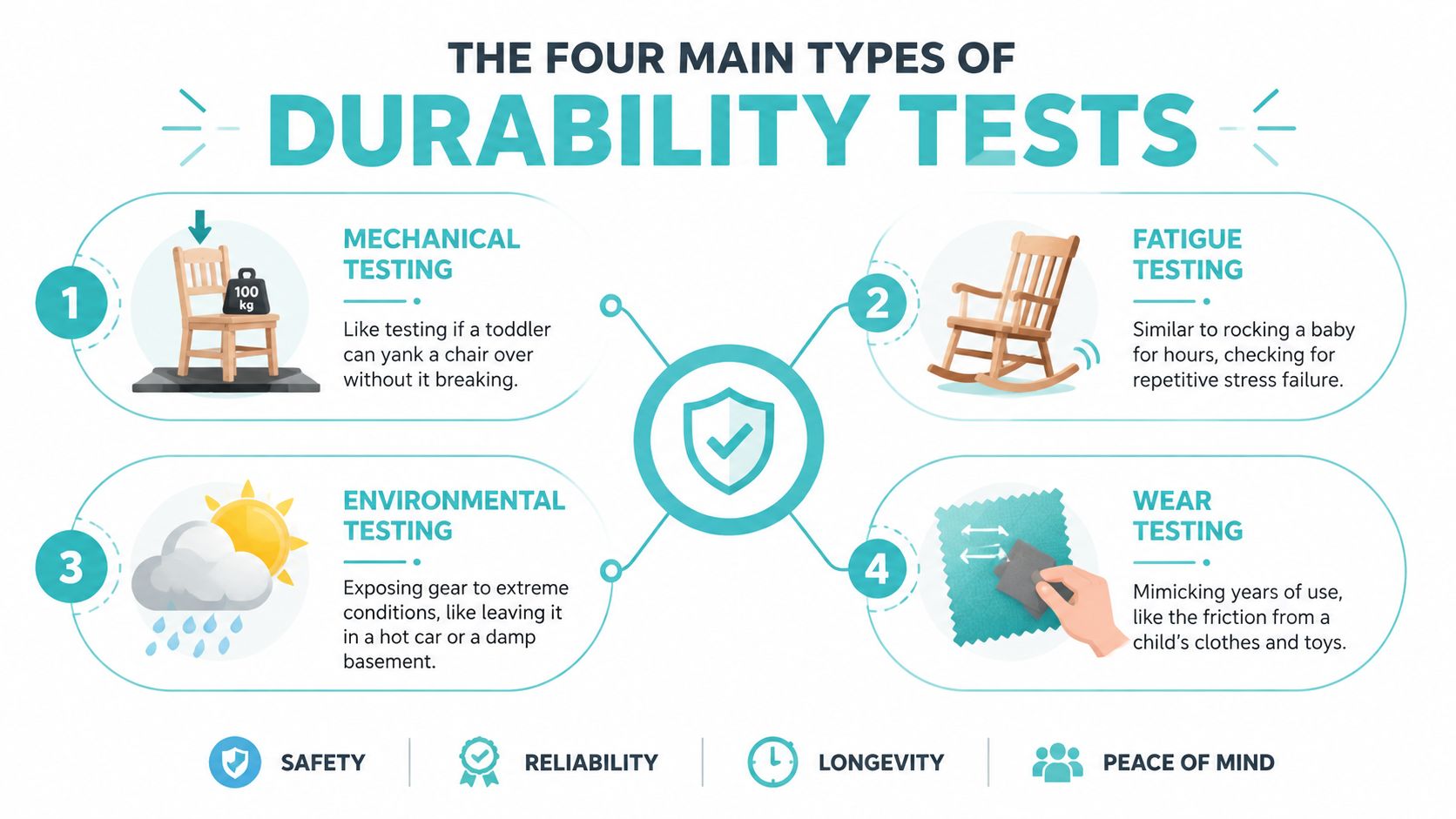
Most durability testing falls into four broad categories. Each one answers a different question, so passing one doesn't make the others unnecessary.
Mechanical testing
Mechanical testing examines immediate strength. A rig may apply load, tension, compression, or impact to a stroller handle, highchair tray, hinge, or frame. The everyday analogy is a toddler pulling hard on a stroller bar while a caregiver tries to turn a corner. Engineers measure whether the part bends, cracks, separates, or continues functioning.
This test can reveal a weak joint quickly, but a single force event doesn't reproduce the cumulative effect of daily use.
Fatigue testing
Fatigue testing repeats a stress scenario because materials can fail after many smaller forces, even when each individual force seems harmless. A laboratory may repeatedly fold a travel crib, cycle a latch, or compress a mattress.
The reason is straightforward. Fatigue damage can progress from crack initiation to crack growth and eventual fracture. Engineers use repeated-load results, including S-N curves and cycle-to-failure data, to characterize service life under realistic stress rather than relying on one static load (Fraunhofer's explanation of fatigue testing).
Environmental testing
Heat, cold, moisture, sunlight, and microbes can change a material's behavior. Environmental testing may use humidity chambers, temperature changes, UV exposure, or moisture and microbial resistance procedures. That helps approximate conditions such as gear stored in a damp basement, a stroller left in a hot vehicle, or fabric exposed to repeated spills.
ASTM's durability resources for nonmetallic materials specifically include weathering, moisture, heat aging, and microbial resistance, because a component can pass an initial strength check and still deteriorate in its environment (ASTM's nonmetallic material durability standards).
Wear testing
Wear testing focuses on surfaces and finishes. Abrasion rigs rub fabric, plastic, or coatings repeatedly. Other procedures may assess scratches, cleaning effects, or the performance of removable fabric parts after laundering.
Standards That Govern Baby Product Durability
Baby-product standards can look like alphabet soup, but each organization has a different role. ASTM International develops consensus standards that manufacturers and regulators may use for product design and testing. The Consumer Product Safety Commission, or CPSC, enforces mandatory federal requirements and addresses hazards such as falls, entrapment, choking, and structural failure.
U.S. law defines durable infant or toddler products as products intended for children under age 5. The category includes cribs, toddler beds, highchairs, strollers, play yards, infant carriers, and baby bath seats. These products are subject to applicable requirements for third-party testing, certification, registration forms, and product markings, with additional performance requirements applying to products covered by specific federal regulations (CPSC's durable infant and toddler product guidance).
A claim such as “safety tested” tells you very little by itself. A named standard and product category provide more useful context.
Baby Product Durability Standards at a Glance
| Organization / Framework | Role | What It Tells You |
|---|---|---|
| ASTM International | Develops consensus standards and test methods | Whether a product or material was evaluated against a specified ASTM requirement or method |
| CPSC | U.S. federal safety regulator and enforcement agency | Whether applicable federal consumer-product safety requirements apply and how compliance is regulated |
| ISO | Develops international standards | Whether a product, process, or laboratory meets the requirements of a particular ISO standard |
| EN | European Standards | Requirements applicable to products sold or evaluated under the relevant European standard |
For example, U.S. crib mattresses are subject to 16 CFR Part 1241, which incorporates ASTM F2933-25 with specific CPSC modifications. ASTM F2933-25 covers design requirements, testing requirements and methods, and labeling requirements for full-size and non-full-size crib mattresses, as well as certain after-market mattresses for play yards, non-full-size cribs, and bassinet accessories of play yards. (the federal crib-mattress rule).
For strollers, EN 1888 testing includes rolling-road durability checks alongside chemical, thermal, mechanical, suffocation, entanglement, choking, and ingestion hazard testing (Intertek's stroller testing overview). International shoppers should look for the EN or ISO equivalent used in their market.
Inside a Real Test How Crib Mattresses Get Evaluated
A crib-mattress evaluation begins with controlled preparation and measurement. Under ASTM F2933-25, mattresses are conditioned under specified temperature and humidity conditions before testing. Technicians then perform the measurements and performance tests required by the applicable standard.
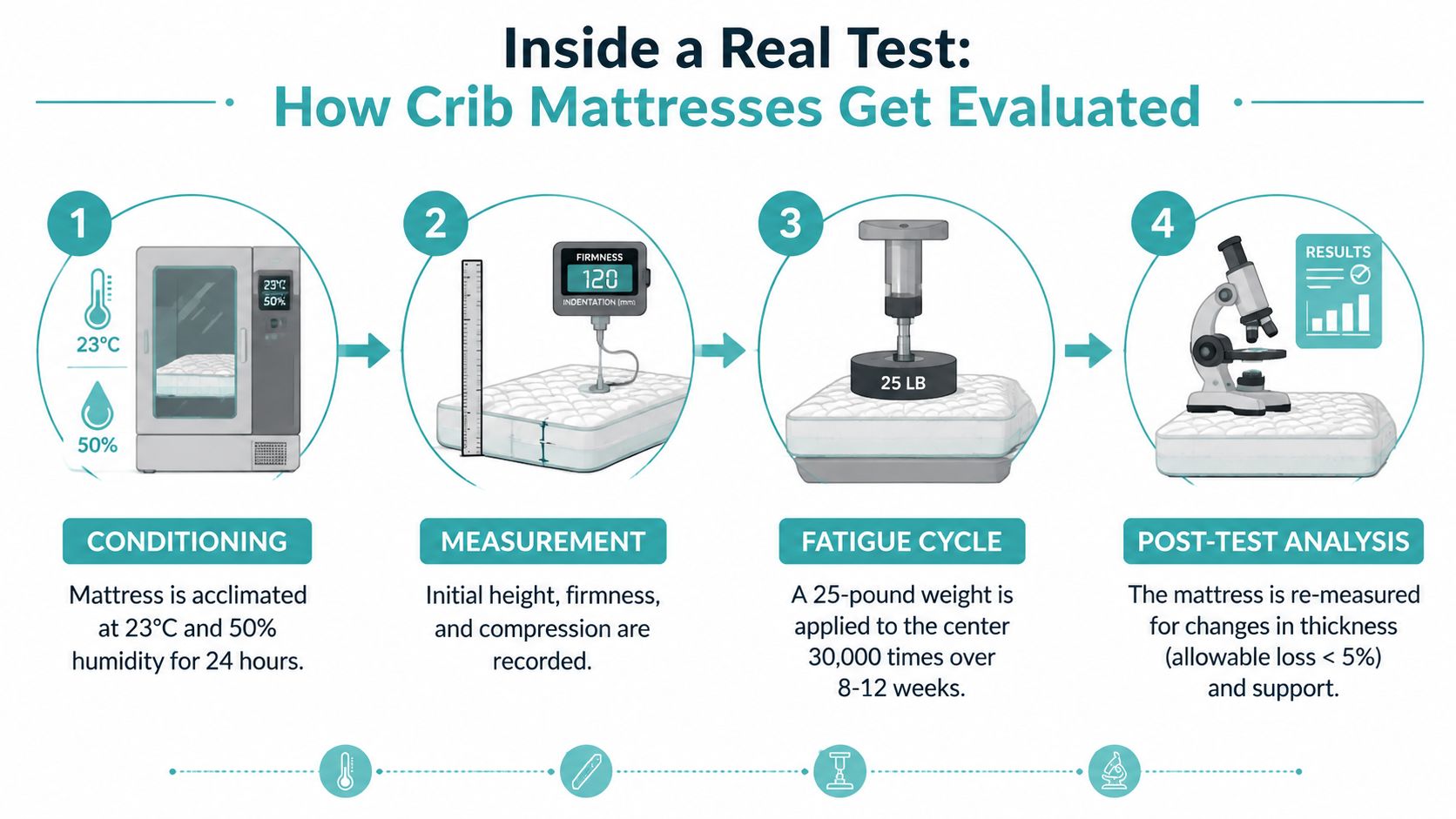
Separate durability evaluations may use controlled loading or repeated-use simulations to study changes in dimensions, seams, materials, or other components. These evaluations are different from the specific mandatory safety tests required under 16 CFR Part 1241.
In a separate durability evaluation, technicians may inspect for permanent indentation, thickness changes, support loss, cover wear, and seam damage. A mattress can change over time if its internal structure develops a permanent set, potentially affecting its dimensions or performance. Edge behavior deserves attention too. An older infant or toddler may lean against the side while turning or pulling up.
A test report compares the results with the applicable criteria for that particular test or standard. Passing is useful evidence of compliance with that method, but it covers only the conditions, locations, and stresses included in the procedure. It does not automatically predict performance after every cleaning method, storage environment, or misuse scenario.
Parents comparing mattresses can review construction and material information alongside test claims. Ask what was measured, where, and after which stresses. A durability test is a structured snapshot, not a crystal ball for years of family use.
How Hiccapop Approaches Testing and Third-Party Verification
A credible testing philosophy starts with the applicable requirement. Hiccapop describes its products as being developed with relevant ASTM and CPSC requirements in mind, along with additional testing intended to evaluate performance beyond applicable regulatory requirements. Required testing establishes a baseline, while additional evaluation may provide insight into areas such as component quality and repeated use.
Third-party laboratories can provide an additional layer of evaluation. ISO/IEC 17025 accreditation indicates that a laboratory has been assessed against requirements for competence, impartiality, and consistent laboratory operations within its accredited scope. Testing conducted by an appropriately accredited outside laboratory can complement a manufacturer's internal testing and provide additional evidence about a product's performance.
That doesn't make every outside test thorough. Parents should still ask what product was tested, which standard or protocol applied, whether the sample represented production, and whether the report identifies the laboratory and certificate details.
Hiccapop describes using third-party testing to verify safety and component quality. Its explanation of independent verification is available in this overview of independent product testing.
A useful filter: “Beyond federal standards” means something when a brand can name the additional protocol and provide traceable documentation. Without that detail, it may be ordinary marketing language wearing a lab coat.
Practical Tips for Parents Evaluating Product Durability
You don't need a materials-science degree to investigate a product's expected life. You need better questions than “Is it safe?”
- Find specific evidence. Search for a named standard, test report, certificate number, or laboratory. “Safety tested” is too broad to tell you whether the product underwent fatigue, environmental, or wear testing.
- Check the applicable rule. A crib, stroller, highchair, and mattress don't share identical requirements. Confirm that the cited standard fits the product category and check whether the manufacturer identifies a current version.
- Match the rating to real use. Compare the product's weight capacity and age guidance with how your family will use it. A stroller used daily for travel faces a different routine from one used occasionally in the neighborhood.
- Inspect the physical build. Look at stitching, fabric thickness, fasteners, hinges, welds, and adjustment points. A product page may list materials, but your hands can still find a loose seam or rough edge during inspection.
- Read reviews for failure patterns. Reviews written after extended use are more revealing than first-day praise. Search for recurring complaints about broken wheels, loose hardware, sagging surfaces, peeling finishes, or parts that become difficult to replace.
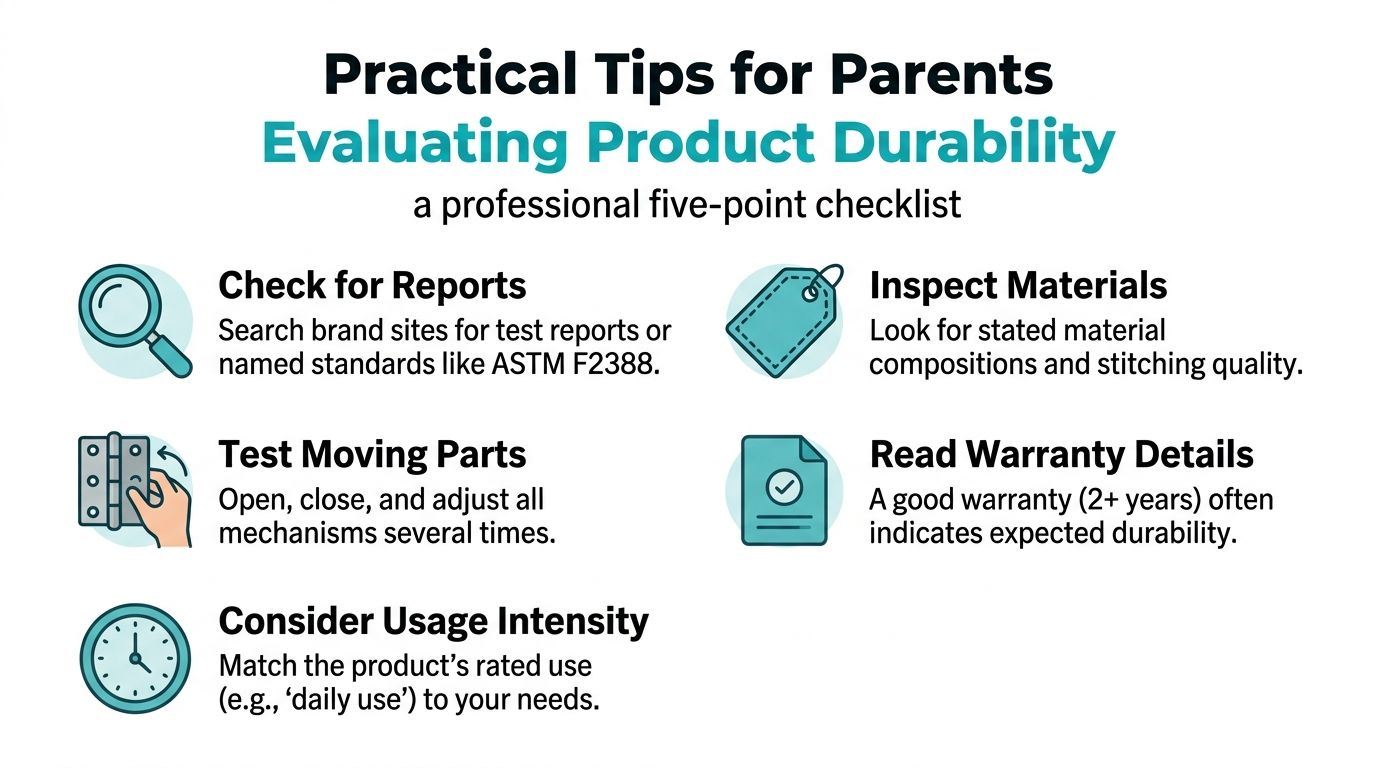
A warranty can also reveal how a brand handles defects, though warranty length alone doesn't prove durability. Hiccapop explains its quality-control approach in this overview of its quality assurance process.
What Durability Testing Does Not Catch
A certified product isn't automatically a product that will last as long as a family hopes. Test methods simulate defined conditions, cycle counts, and hazards. They can't reproduce every garage temperature, toddler bite, overloaded basket, detergent, sun angle, or rushed folding attempt.
Accelerated aging helps engineers study long-term effects more quickly, but heat and humidity chambers don't perfectly recreate natural environments. ASTM's statistical weathering guidance, including G169-01(2021), recognizes the need for statistical methods when interpreting natural and laboratory weathering results (ASTM's weathering guidance).
Production variation creates another limitation. A tested sample can meet requirements while a damaged, poorly assembled, or otherwise atypical unit reaches a customer. That's why quality systems, production checks, traceability, and recall monitoring matter alongside laboratory results.
Independent research from the PROMPT project also highlights gaps in product-specific durability testing. The project notes that lifetime and durability measurements can be costly and time-consuming and argues that existing tests do not always capture the failure mechanisms products experience over their useful lives.
Parents should layer test claims with warranty terms, replacement-part availability, brand communication, and long-term owner experience. Hiccapop also discusses product longevity in its product lifespan guide.
Frequently Asked Questions About Durability Testing
How long does a durability test take?
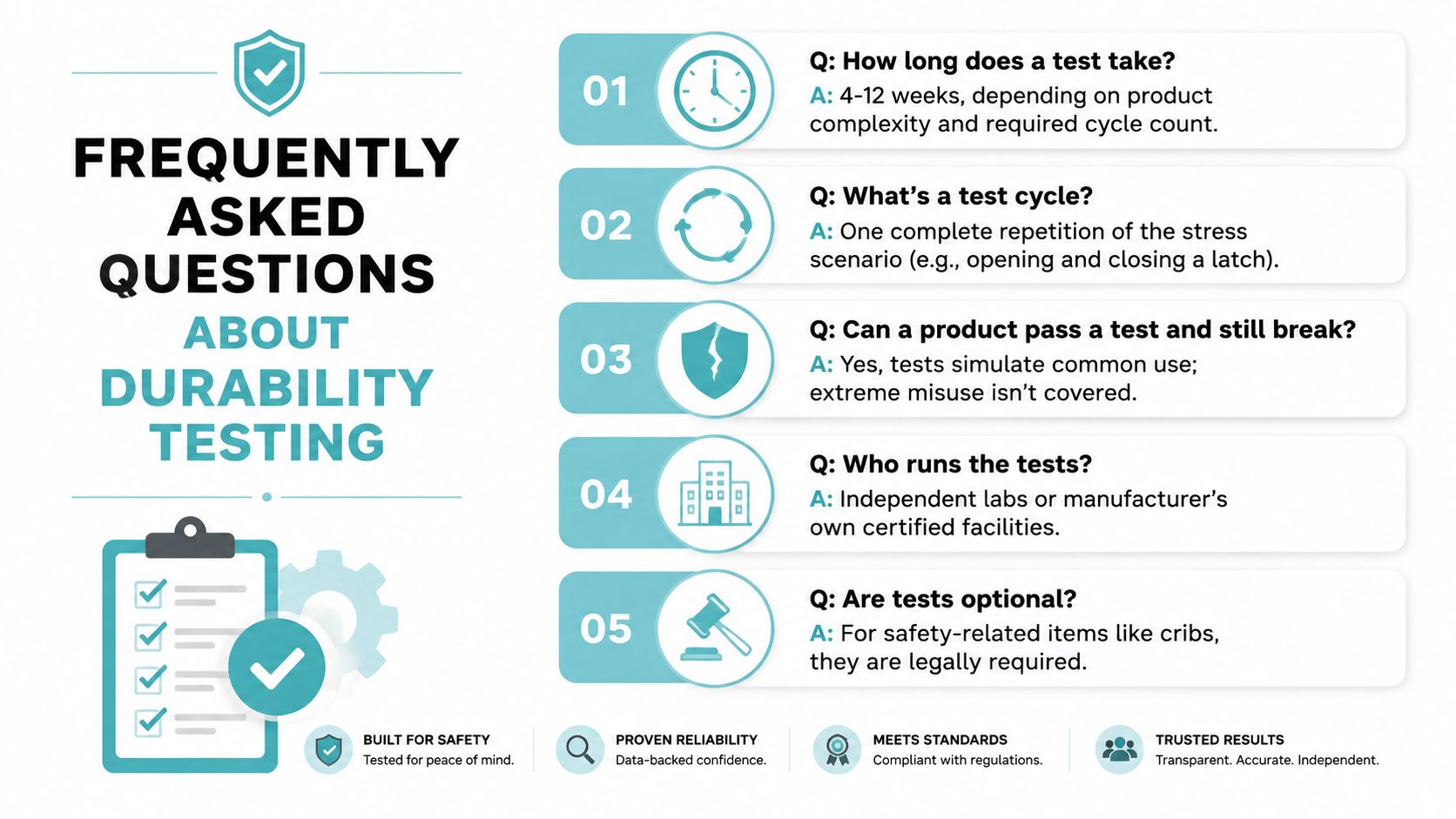
It depends on the product, test method, and required cycle count. A simple component check may be relatively quick, while a complex product requires conditioning, repeated loading, environmental exposure, inspections, and reporting.
What does “tested to ASTM” mean?
It generally indicates that a product or sample was evaluated using an ASTM method. It doesn't automatically mean that ASTM certified the product, because ASTM develops standards rather than serving as a universal certification body.
Is “certified by an accredited lab” stronger?
That wording identifies an independent testing relationship, but you still need the scope. Ask which lab performed the work, which standard applied, what model or component was tested, and whether the report covers safety, durability, or both.
Do hand-me-down products need new testing?
They don't normally need to be re-tested by the next family, but they do need careful inspection. Check for wear, missing parts, recalls, damaged hardware, and compliance with current requirements before using them.
Before buying, look for the product category, named standard, testing laboratory, report or certificate details, maintenance instructions, warranty, and replacement-part policy. For U.S. products, the CPSC's accepted-laboratory and product-safety resources provide useful context, while recall information can help you investigate a specific model.
Hiccapop offers baby and toddler products such as travel beds, booster seats, crib mattresses, and nursery organizers, with product development informed by ASTM and CPSC requirements and additional testing claims. Visit Hiccapop to review product details and choose gear with durability questions in mind, not just a “passes all tests” promise.