


Antimicrobial Mattress Cover Guide for Babies
An antimicrobial mattress cover is a textile treated to slow microbial activity on the fabric itself. It isn't the same as waterproofing, allergen control, or guaranteed protection against infant illness.
That distinction gets lost in plenty of product descriptions. A label can sound like a promise of a cleaner sleep space, but “antimicrobial” can refer to a treatment intended to preserve the material or reduce microbes on the treated surface. It doesn't automatically mean the mattress stays uncontaminated, the cover blocks leaks, or a baby is protected from infection.
For parents, the useful question isn't whether a cover is antimicrobial. It's what the treatment is meant to do, how the cover fits the crib, and whether its barrier and care instructions suit daily life.
Disclosure: Hiccapop makes and sells the Dual-Sided Foam Crib Mattress mentioned in this post.
Why the Word Antimicrobial Deserves a Closer Look
An antimicrobial treatment may have a role in a mattress cover, but the word alone doesn't tell you how much protection the finished product provides. In a 2006 outbreak report from an intensive care unit in Tours, France (van der Mee-Marquet et al., Critical Care, 2006), researchers examined six antibacterial-treated, vapor-permeable polyurethane mattress covers. They found high levels of bacterial contamination on every cover and on the underlying mattress foam. Environmental and clinical strains were linked to patients, and at least three of the mattresses were judged the probable sources of the outbreak.
The lesson isn't that antimicrobial treatments are useless. Mattress covers can serve as a barrier, and material treatments may have a specific purpose. The lesson is that a treatment doesn't sterilize a cover or guarantee that contamination can't reach the mattress. Construction, seams, liquid resistance, cleaning, and damage all matter.
Treat the label as a question
Ask what the treatment is designed to affect. Is the claim about odor-causing bacteria on the fabric, preserving the textile, or reducing a particular organism under stated test conditions? Those are different claims, and none automatically means a baby is protected from illness.
Hospital evidence also needs context. A 2015 study in two Indiana long-term acute care hospitals (Hooker et al., American Journal of Infection Control) found that launderable mattress and bed-deck covers, changed after every patient and washed with hot water, detergent, and chlorine, were associated with 47.8% fewer hospital-onset C. difficile infections at one hospital and 50% fewer at the other. Those results came from hospitals with strict laundering protocols. They aren't proof that any consumer antimicrobial mattress cover will produce the same effect at home.
Practical rule: Choose a cover for its fit, barrier, and cleanability first. Consider antimicrobial treatment only as a clearly described additional feature.
Antimicrobial vs Waterproof vs Anti-Allergen Covers
These labels describe different jobs. Think of a mattress cover as a layer between the sleeper and the mattress: one feature may limit liquid transfer, another may reduce exposure to certain particles, and another may act on microbes on the treated fabric. A product can combine features, but one label doesn't imply the others.
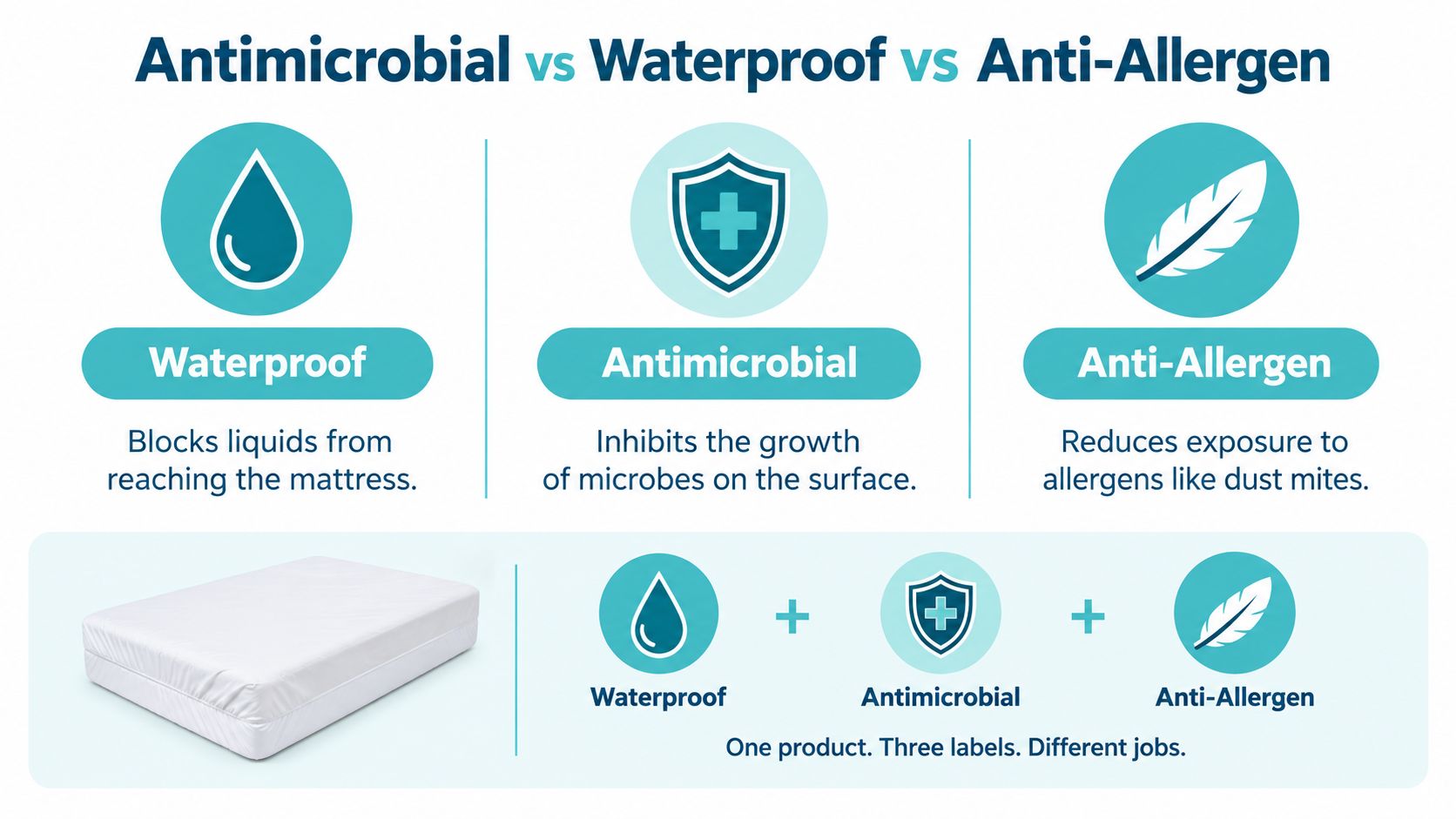
Compare the job, not the buzzword
| Cover type | Primary job | What it doesn't do | Best for |
|---|---|---|---|
| Waterproof | Helps block liquids from reaching the mattress | Doesn't automatically reduce microbes or allergens | Diaper leaks, spit-up, and other moisture |
| Antimicrobial | Targets microbial activity on the treated fabric, depending on the treatment and claim | Doesn't automatically waterproof, sterilize the mattress, or prevent illness | Caregivers seeking a defined fabric-treatment benefit |
| Anti-allergen | Helps limit exposure to specified allergens through its barrier construction | Doesn't automatically block liquids or kill microbes | Families managing exposure to allergens such as dust mites |
A waterproof layer is the feature that addresses a leak. An anti-allergen barrier is intended to limit contact with certain particles. An antimicrobial treatment acts on microbes on the treated surface, but its performance depends on the treatment and how it was tested. Read the product description for each feature separately, rather than assuming that a cover with several labels performs every job equally well.
For a wet crib mattress, moisture control and prompt cleaning are still central, but they don't change the basic setup: the AAP advises a firm, flat crib mattress that fits tightly, covered only by a fitted sheet, with nothing else in the crib.
How Antimicrobial Treatments Work and What Regulators Allow
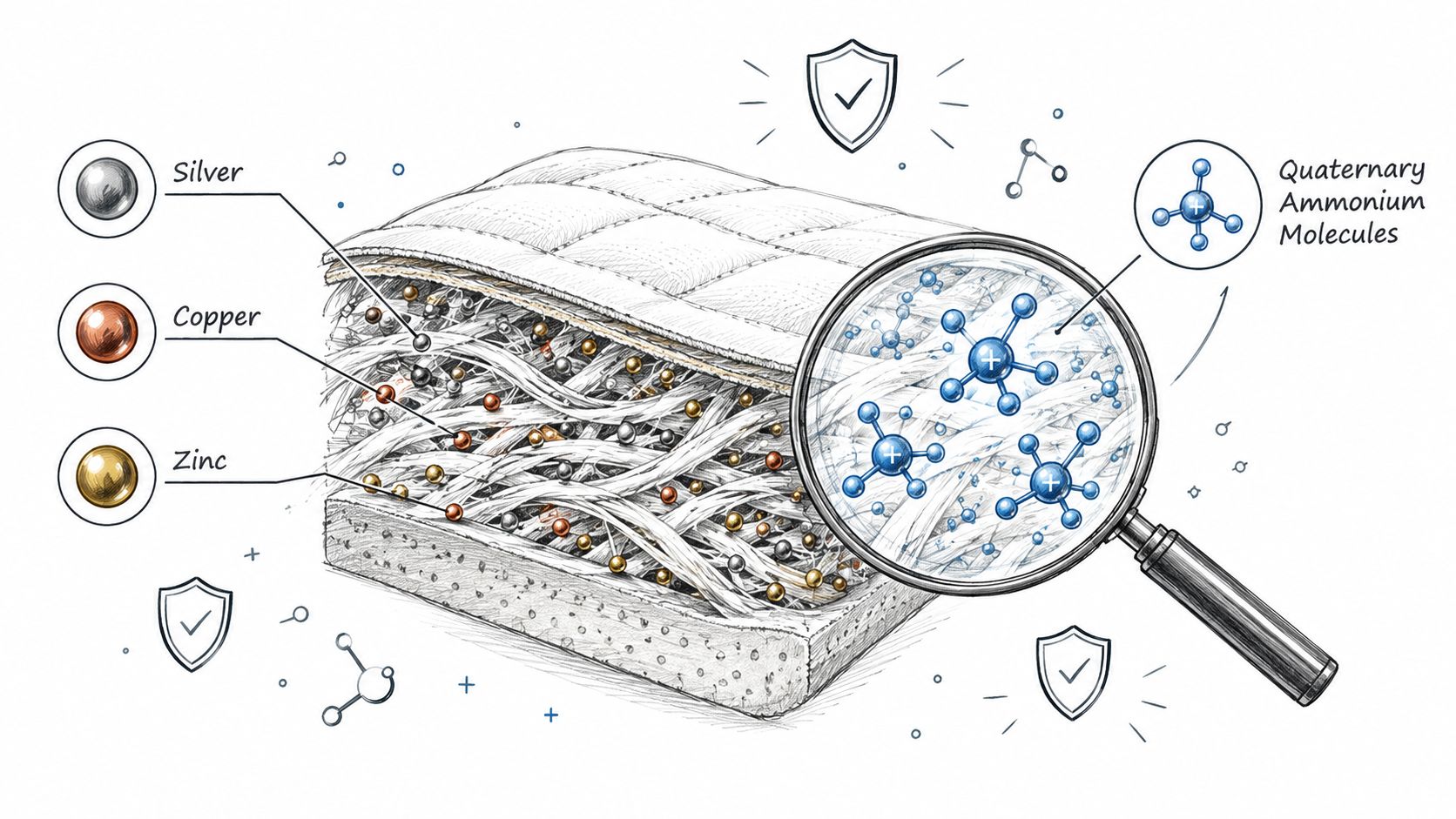
Antimicrobial covers can use different active treatments, including silver-, copper-, zinc-, or quaternary-ammonium-based technologies. The word “antimicrobial” doesn't identify which one is present, how it works, or which organisms it has been tested against. Ask the maker to name the treatment and describe the purpose of the claim.
In the United States, a treated article can skip EPA pesticide registration only when the antimicrobial protects the article itself and the pesticide is registered for that use (40 CFR 152.25(a)). According to EPA guidance on consumer products treated with pesticides, claims to kill germs or to control named bacteria such as E. coli or S. aureus are public-health claims that require registration. CDC's infection-control guidelines add that there's no evidence antimicrobial-treated items such as mattresses and bed linens make people healthier or prevent disease.
That means a claim about maintaining or protecting the fabric shouldn't be read as a promise to protect a child. Wording such as “helps inhibit odor-causing bacteria on the cover” is narrower than saying a product prevents infection or disinfects a mattress. Those statements describe different outcomes and require different support.
Crib-Fit Safety Rules That Come Before Any Treatment
A crib cover must fit the mattress and preserve the intended sleep surface. The CPSC advises placing babies on their backs on a firm, tight-fitting mattress in a crib that meets current safety standards. It also says the crib sheet must fit snugly, overlap the mattress securely, and stay attached when the corners are pulled (CPSC guidance on crib mattress and sheet hazards).
For a non-full-size crib mattress, CPSC rules say the gap between the mattress perimeter and crib perimeter can't exceed ½ inch at any point when the mattress is centered, or 1 inch at any point when it's pushed against one side. When the mattress support is at its lowest position, at least 20 inches must remain between the mattress top and the top of the crib side or end panel (CPSC non-full-size crib FAQ). A thick or poorly sized cover can affect how the mattress sits, so check the mattress and cover specifications together.
For a full-size crib, use a mattress at least 27¼ by 51¼ inches and no more than 6 inches thick (16 CFR 1219; see also the CPSC full-size crib FAQ), and follow your crib's manual, including its mattress support positions.
Check the complete sleep setup
If you use a mattress cover, choose a thin, snug one that the mattress maker allows, put the fitted sheet over it, and make sure it doesn't bunch or soften the surface. Never add a pad or topper for softness. Don't use an adult sheet, or a cover that changes the fit of the sleep surface, regardless of its treatment.
Parents comparing requirements can also review this crib mattress safety standards guide.
Materials and Test Claims Worth Checking
A product page may list fabric type, waterproof construction, third-party standards, and antimicrobial testing. These details answer different questions. A chemical or emissions standard doesn't establish that an antimicrobial claim works, while a microbial test doesn't tell you whether the cover fits a particular crib.
ASTM E2149 is a dynamic shake-flask test for antimicrobial-treated specimens, developed for routine quality control and screening. It compares results from the treated sample with controls run at the same time. ASTM notes that the method may not be appropriate for all treated articles or antimicrobial agents, and that the right test depends on the antimicrobial's mode of action and end-use expectations.
Ask what the test actually covered
A result from an exposed textile sample may not predict the performance of a finished cover after laundering, abrasion, body oils, or compression. Ask the manufacturer:
- Organisms: Which organism or organisms were tested?
- Conditions: What was the contact time, and was the finished cover tested?
- Durability: Was efficacy checked after repeated washing, drying or heat, detergents, and sweat or body oils?
- Comparison: Was an untreated control included, and what log reduction was measured?
Construction matters too. Woven materials, laminated barriers, and different seam finishes can affect breathability, liquid resistance, and cleaning. Bound or sealed seams may help reduce routes for liquid penetration, but the finished cover still needs to fit securely and tolerate care according to its label. For more on cover construction, see this guide to mattress cover materials.
Care, Cleaning, and When Antimicrobial Claims Fade
A cover's care life matters as much as its initial claim. Repeated washing can change fabric appearance and fit, and product labels may not make clear whether antimicrobial performance was tested after laundering. In a 2022 test by Hong Kong's Consumer Council of 15 bed sheets and mattress protectors sold there with antibacterial or anti-dust-mite claims, seven performed poorly on antibacterial testing, most shrank or faded after repeated washing, and some labels were unclear or inaccurate.
Make care part of the buying decision
Follow the cover's care label rather than applying a one-size-fits-all wash temperature or dryer setting. Clean bodily fluids promptly, wash the cover as directed, and dry it thoroughly. Don't assume a treatment survives repeated washing unless the manufacturer provides test details for care cycles.
Inspect the cover when laundering. Look for torn fabric, separated seams, shrinkage that changes the fit, coating damage, or signs that liquid may be reaching the mattress. If the cover no longer fits securely or its barrier appears damaged, replace it; the antimicrobial label can't compensate for a failed physical barrier.
For practical cleaning steps, use this guide to cleaning a mattress cover. If the mattress or cover remains damp, address the moisture promptly: California public-health guidance notes that mold can grow quickly on porous materials, like fabric and foam cushions, that have gotten wet (California Department of Public Health mold and moisture guide).
Real Buying Scenarios for Cribs and Travel
A parent preparing a nursery may be choosing between one cover that combines waterproofing and antimicrobial treatment, or a simpler waterproof cover. Start with the practical need: if leaks are the concern, verify liquid resistance, fit, washability, and the mattress's firmness. Treat antimicrobial performance as a separate claim to investigate, not a reason to accept a less suitable barrier.
A family using a portable crib at a grandparent's home should check the exact mattress and manufacturer guidance. Don't assume a cover that fits a standard crib mattress will fit a travel mattress; a loose or bunched layer can undermine the setup. Breathability and cleaning matter, but neither makes a poor fit acceptable.
For a baby-shower gift, ask which mattress the family owns before buying. A cover that fits that mattress and can be cleaned reliably is more useful than a broad antimicrobial promise with no clear test conditions. Match the product to the actual sleep surface, then judge its added claims.
FAQs and the Bottom Line for Parents
Can a baby sleep directly on an antimicrobial cover?
Follow the product instructions and infant sleep guidance. The CPSC calls for a firm, tight-fitting mattress and a snugly secured crib sheet, so don't treat an antimicrobial cover as a reason to skip the fitted sheet.
What should parents ask about silver treatment if a baby mouths the cover?
The label alone doesn't answer exposure questions. Ask the manufacturer what treatment is used and what infant-use information supports the product.
When should a cover be replaced?
Replace it if it tears, stops fitting securely, or shows damage that could compromise its barrier. An antimicrobial claim doesn't make a worn cover reliable.
If you're shopping for a crib mattress, the Dual-Sided Foam Crib Mattress has a removable, machine-washable waterproof cover. Check its listed dimensions against your crib's instructions before you buy.