


The Best Educational Toys for 1-Year-Olds (and How to Use Them)
Walking into the toy aisle can feel like stepping into a chaotic wonderland, especially when you're on the hunt for something for your newly minted one-year-old. But here’s the secret: picking the right toy is simpler than you might think. For a one-year-old, playtime isn't just a way to kill time—it's how they do their most important work: learning about the world. The best 1 year old educational toys are really just tools that help them build crucial connections in their incredible, fast-growing brains.
Why Educational Toys Are More Than Just Fun
At age one, your child's brain is in the middle of a massive growth spurt. Every single interaction—every new texture they touch, every sound they hear—is busy forging new neural pathways. Play is the engine driving all this development, and educational toys are the high-octane fuel.
These toys are specifically designed to be more than just entertaining distractions. They’re catalysts for growth, helping to shape cognitive, physical, and even emotional skills.
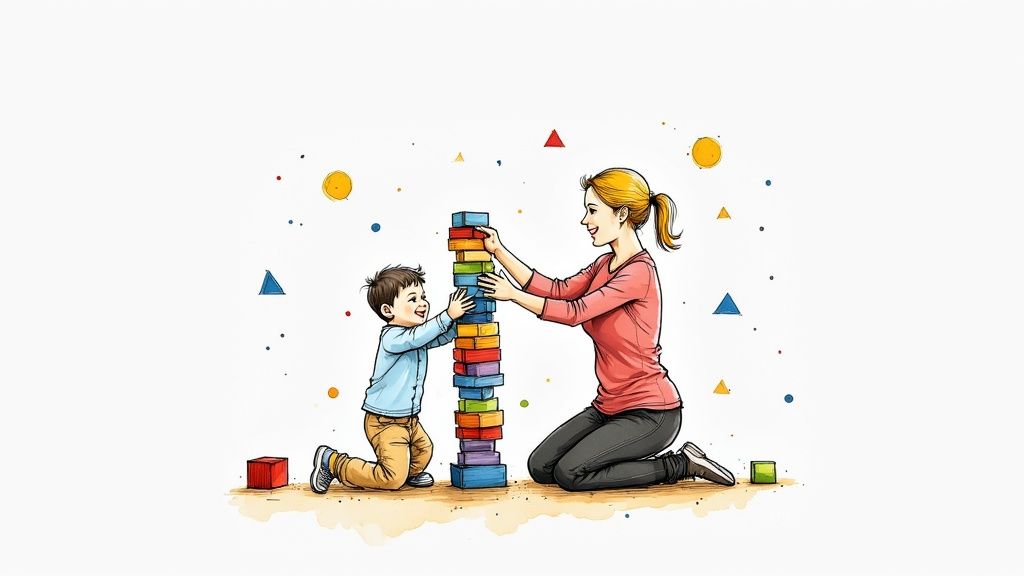
Think about it like this: when your little one finally manages to stack one block on top of another, they're not just building a tiny tower. They're actually running a mini-physics experiment, figuring out balance, gravity, and spatial relationships all at once. When they fit a chunky puzzle piece into its slot, they're honing problem-solving skills and fine-tuning their hand-eye coordination. It’s some serious business disguised as a good time.
The Building Blocks of a Bright Future
These moments might seem small, but they are huge milestones in your child's development. The right toys are designed to nurture the essential skills that lay the foundation for future learning and self-confidence. They challenge a toddler just enough to spark curiosity and encourage them to keep trying, without causing a full-blown meltdown.
Here’s a quick look at what the best educational toys bring to the table at this age:
- Boosting Motor Skills: Toys that your child can grasp, push, pull, and stack are fantastic for developing both fine motor skills (like that all-important pincer grasp) and gross motor skills (powering crawling and those first wobbly steps).
- Fostering Cognitive Growth: Simple things like shape sorters, basic puzzles, and nesting cups introduce big concepts like cause-and-effect, object permanence, and the basics of problem-solving.
- Encouraging Language Development: Toys that make sounds, or even simple board books with bright pictures, open the door for you to talk, sing, and introduce new words, helping their vocabulary blossom.
Ultimately, choosing the right educational toys is about investing in your child's innate curiosity. It’s about giving them the tools they need to explore, discover, and make sense of their world in a way that’s both joyful and profoundly important.
How Play Shapes Your Toddler's Growing Brain
At one year old, your child's brain is an absolute beehive of activity. It’s hard to wrap your head around, but it’s forming more than a million new neural connections every single second. And what’s the main thing fueling all this incredible growth? Something wonderfully simple: play.
Every time your little one interacts with a toy, they're not just passing the time—they're strengthening those vital brain connections.
Think about what happens when your toddler uses their thumb and forefinger to pick up a small block. That little move is called the pincer grasp, and it's a huge deal. They aren't just moving an object; they're fine-tuning the motor skills that will one day let them hold a crayon or button a shirt. It’s a foundational workout disguised as fun.
It’s the same when they push a toy car and watch it zoom away. That’s not just a game; it's their very first physics experiment. This simple action introduces the powerful concept of cause and effect, which is a cornerstone for logical thinking and problem-solving later on.
This infographic really brings to life how these basic play activities are powering major developmental leaps.
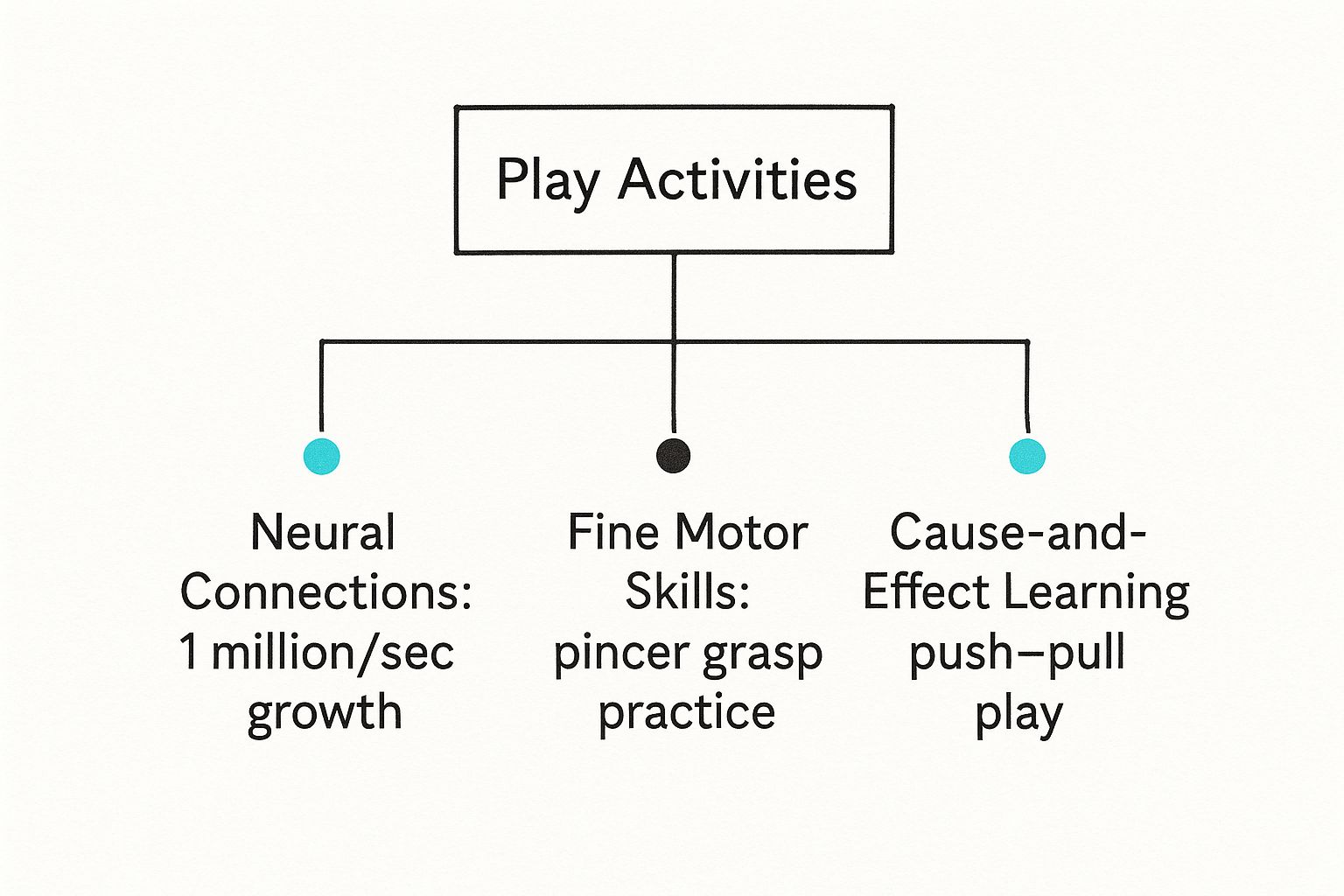
As you can see, even the most straightforward actions—like grasping or pushing a toy—are directly wiring your child's brain for more advanced skills.
From Simple Actions to Complex Skills
The link between a simple playtime activity and your child's cognitive development is incredibly deep. Banging on a toy drum isn't just about making a racket; it's a hands-on exploration of rhythm and sensory input. Successfully fitting a square block into a square hole is a masterclass in spatial awareness and a concept called object permanence—the idea that things still exist even when you can't see them.
These moments are the real work of childhood. It's no wonder that U.S. parents have such a strong preference for toys that build skills. The educational toy market in the U.S. was on track to reach about $8.5 billion by 2025, with around 90% of preschoolers using toys like building blocks for developmental activities. This isn’t just a trend; it shows that parents understand just how serious play is for a child's brain.
Play is often talked about as if it were a relief from serious learning. But for children, play is serious learning. Play is really the work of childhood. – Fred Rogers
Nurturing Social and Emotional Growth Through Play
Beyond sharpening the mind and strengthening little hands, play is also the very first classroom for social and emotional learning. When you roll a ball back and forth with your toddler, you're not just playing a game. You're teaching them about turn-taking and cooperation, the fundamental building blocks of social skills. You can learn more about this crucial connection and how to nurture your baby's social development in our guide.
This goes way beyond specific toys, touching on the core of early development. For more insights, it's worth understanding Social Emotional Learning (SEL) and how it works. Through play, toddlers start to recognize and manage their big feelings in a safe, supported way. This perspective helps you see playtime for what it truly is: the most important job your child has.
What To Look For When Choosing The Right Toys
Walking into the toy aisle can feel like stepping into a sensory overload. Flashing lights, loud jingles, and promises of genius-level development are everywhere. So, how do you cut through the noise and find a toy that’s truly educational, not just a five-minute distraction?
The secret is to look for toys that grow with your child. Many flashy, battery-operated toys do one thing, and once your toddler figures out which button to press, the discovery phase is over. The best 1 year old educational toys are often the simplest because they are open-ended.
An open-ended toy is like a blank canvas; it can become anything your child imagines. A simple set of wooden blocks can be a tower, a car, a fence for toy animals, or a bridge. This flexibility sparks creativity and problem-solving skills that grow right along with your child.
A Practical Checklist For Toy Shopping
To make your next trip to the toy store a success, keep this simple checklist in your back pocket. It's an easy way to see past the bright packaging and evaluate a toy's real, long-term value.
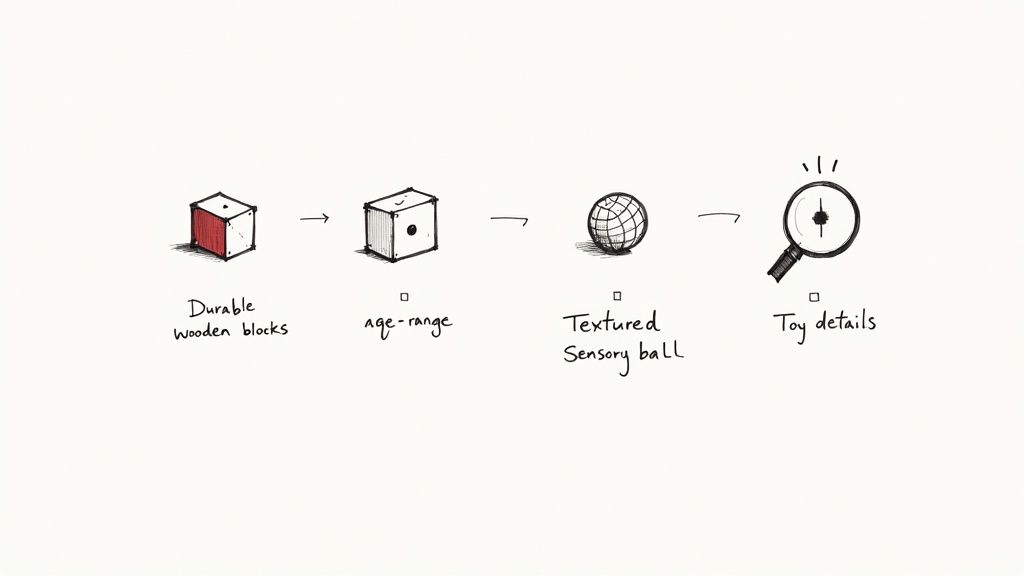
- Age-Appropriateness: Does the toy offer a gentle challenge without being frustrating? For a one-year-old, this sweet spot includes things like chunky puzzle pieces with knobs they can easily grasp or stacking rings that are wide enough for little hands to handle.
- Durability and Quality: Let's face it, toys for one-year-olds are going to be dropped, thrown, and probably taste-tested. You need something built to last. Look for sturdy construction and high-quality, non-toxic materials that can survive a year of enthusiastic play.
- Multi-Sensory Engagement: Does the toy engage more than just their eyes? Toys with interesting textures to touch, gentle sounds to hear, and vibrant colors provide a much richer learning experience, helping build stronger neural connections.
Features That Foster Growth
Beyond the basics, certain features can really boost a toy's developmental power. Think about what a toy asks your child to do. Does it invite them to explore, experiment, and figure things out on their own?
A shape sorter, for instance, is more than just a matching game; it's an early introduction to logic and spatial awareness. Push-and-pull toys are fantastic for building confidence and coordination as your little one masters walking and balance.
The table below breaks down exactly which features support specific developmental milestones, helping you connect the dots between play and progress.
Developmental Toy Features for a One-Year-Old
| Developmental Domain | Key Skills Being Learned | Look for These Toy Features |
|---|---|---|
| Fine Motor Skills | Pincer grasp, hand-eye coordination, wrist rotation | Knobs, dials, large puzzle pieces, stacking rings, chunky blocks |
| Gross Motor Skills | Walking, balance, climbing, pushing, pulling | Ride-on toys, push walkers, soft play climbers, balls |
| Cognitive Development | Cause-and-effect, object permanence, problem-solving | Shape sorters, nesting cups, pop-up toys, simple puzzles |
| Language Skills | Vocabulary building, object identification, listening | Board books with simple pictures, toy phones, animal figures |
| Sensory Exploration | Exploring textures, sounds, and colors | Textured balls, crinkle books, blocks of different materials, musical instruments |
By focusing on toys with these kinds of purposeful features, you can feel confident that you’re not just buying another thing to clutter up the playroom.
Ultimately, the best toys help create a supportive environment for discovery. Of course, the space itself matters, too. For some great tips for decorating your kid's bedroom, check out that guide for a more holistic approach. By choosing wisely, you can turn playtime into a powerful engine for your child's learning journey.
Prioritizing Safety in Your Toddler's Playtime
For a one-year-old, the world is a giant buffet, and just about everything looks delicious. This mouth-first approach to discovery is totally normal, but it means that when you’re choosing 1 year old educational toys, safety has to be your top priority. After all, the best toy is one that comes with peace of mind.
Your first line of defense is always the material a toy is made from. Since you can bet that new toy will be chewed, licked, and drooled on, what it’s made of really matters.
Choosing Safe Materials
When it comes to plastics, always look for a clear BPA-free label. Many parents also lean towards food-grade silicone; it’s wonderfully durable, soft enough for teething gums, and doesn’t contain nasty chemicals.
If you love the classic feel of wooden toys, make sure they have smooth, sanded edges to keep tiny hands splinter-free. The finish is just as important—it should always be non-toxic and water-based. A well-made wooden toy isn't just safe; it's an heirloom in the making.
The global educational toys market was valued at around $79.78 billion in 2024 and is expected to skyrocket to $239.32 billion by 2035. What’s driving this? Parents like you, who are demanding safer, eco-friendly, and truly beneficial toys. This trend is pushing manufacturers to ditch the toxins and focus on quality. You can see more on this in this market analysis.
Spotting Common Hazards
Beyond the materials, the actual design of a toy is crucial for preventing accidents. For one-year-olds, the biggest dangers are choking and entanglement. The good news is that you can learn to spot these risks from a mile away.
Here are a few key hazards to keep on your radar:
- Choking Risks: Small parts are the number one enemy. A great at-home trick is the 'toilet paper roll test.' If any part of a toy—or a piece that could break off—can fit completely inside an empty toilet paper roll, it’s a choking hazard. Simple as that.
- Detachable Parts: Give the toy a good once-over. Are there buttons, plastic eyes, or wheels that a determined toddler could pull or chew off? Gently tug on everything to make sure it’s securely attached.
- Long Cords or Strings: Any string longer than 12 inches is a potential strangulation risk. This is why you should be cautious with pull-toys that have long ropes or any item with a cord that could get tangled.
- Magnets and Batteries: Small, high-powered magnets are incredibly dangerous if swallowed. The same goes for button batteries. If a toy has a battery compartment, it absolutely must be secured with a screw.
Staying vigilant about these potential issues helps you create a play space where your little one can explore safely. For a more comprehensive look at home safety, check out our guide on the best baby safety products to help you baby-proof with confidence.
Top Categories of Educational Toys for 1-Year-Olds
Alright, now that we've covered the "why," let's get to the fun part—the "what." Instead of just giving you a long list of products, it’s much more helpful to think in terms of categories. We've grouped the best educational toys for 1-year-olds by the skills they help build.
This way, you can easily zero in on what your little one is working on right now, whether it's mastering their pincer grasp or taking those first wobbly steps.
Building and Stacking Toys
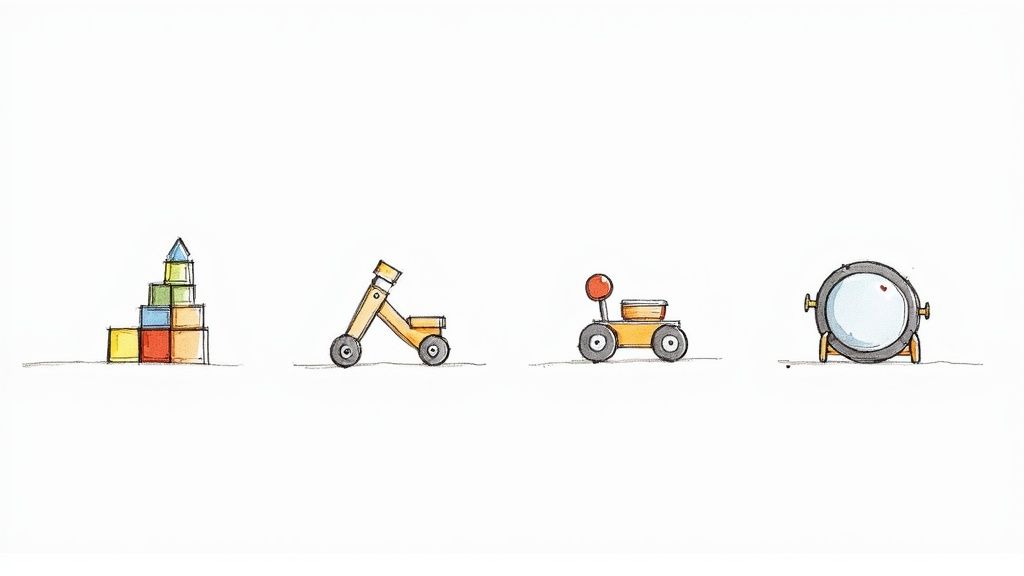
You just can't beat the classics. Building and stacking toys are the undisputed champions of the toddler playroom for a very good reason. Think chunky wooden blocks or a simple set of colorful nesting cups—these are absolute powerhouses for developing fine motor skills and spatial reasoning.
Every time your child carefully tries to place one block on top of another, they're running a tiny physics experiment. They're learning about balance, gravity, and cause-and-effect in the most hands-on way possible. It's foundational stuff for problem-solving down the road.
Shape Sorters and Simple Puzzles
Shape sorters and big, chunky puzzles with knobs are brilliant for connecting what the eyes see with what the hands do. When your one-year-old is determined to get that square peg into the square hole, they're getting a serious mental workout.
It’s a fantastic, low-frustration way to introduce them to recognizing shapes, understanding how objects relate to each other in space, and the simple joy of trying until you get it right.
Push and Pull Toys
Once your toddler starts cruising and walking, push and pull toys become their best friends. A sturdy wooden walker filled with blocks or even a simple duck on a string encourages them to get moving and practice their new skills.
These toys are amazing for building confidence and gross motor skills. They help strengthen little legs and core muscles, turning those shaky first steps into more confident strides across the living room.
The market for educational baby and toddler toys was on track to hit USD 25 billion by 2025. This isn't just a random trend; it shows a real shift where parents are actively choosing interactive, sensory toys that give cognitive and motor skills a boost. You can discover more insights about this on archivemarketresearch.com.
Sensory and Musical Toys
At one year old, the world is a giant sensory playground. That’s why toys that engage multiple senses—like a set of textured balls, a crinkly fabric book, or a simple xylophone—are such effective learning tools.
These toys fire up their auditory and tactile systems, helping their brain build stronger connections as it processes all this new information. Musical toys, in particular, are wonderful for introducing rhythm and sound, which actually lay the groundwork for language and creativity later on. And for more contained, safe, and stimulating fun, you might be interested in our guide to the best baby activity bouncers, which are another great option for sensory engagement.
The Secret Ingredient? It’s You.
After all the talk about the best toys, safety checks, and developmental milestones, let's get to the most powerful educational tool your one-year-old will ever have: you.
Think of it this way: the right toys are like a great set of ingredients. But it's your interaction—your engagement and enthusiasm—that really cooks up the magic. You're the one who turns simple play into rich, lasting learning.
You don’t have to be a child development expert. You just have to be there, present and ready to play. That's the secret sauce that makes every toy ten times better.
How to Turn Playtime into a Shared Adventure
When you get down on the floor and join in, you’re not just playing; you’re building a world of connection and understanding for your little one. Your simple actions have a massive impact.
Here are a few ways to make that happen:
- Be Their Narrator: As your child stacks a block, you can say, "Wow, you put the blue block on top of the red block!" This simple play-by-play builds their vocabulary and helps them link words to actions. It’s like being the sportscaster for their own little world series.
- Cheer for the Effort, Not Just the Win: When they get a puzzle piece almost in the right spot, give them a little cheer! Celebrating the trying part teaches resilience and confidence. It shows them that the fun is in the figuring-it-out, not just getting it right.
- Ask Open-Ended Questions: Even simple ones work wonders. Point to a shape sorter and ask, "Where do you think this one goes?" This nudges them to think and solve problems, with you as their trusted co-pilot.
These little moments of shared discovery do more than just teach them about shapes and colors. They build a foundation of love, security, and curiosity that will support them for the rest of their lives.
Frequently Asked Questions About Toddler Toys
Stepping into the world of toddler toys can feel a bit like navigating a maze. So many options, so many questions! Trust me, you're not the first parent to wonder about these things. Let's clear up some of the most common queries we get about the best 1 year old educational toys.
How many toys does a one-year-old really need?
When it comes to a one-year-old's toy box, less is almost always more. It's easy to think a mountain of toys equals endless fun, but it often has the opposite effect. Too many choices can be overwhelming for a little one, causing them to bounce from one toy to the next without ever really digging in and exploring.
The real goal here is quality over quantity. A small, thoughtful collection of open-ended toys will do so much more for their development than a room overflowing with one-trick ponies. Try to have a few key players: something for building, a toy for fine motor practice, a push-toy for those gross motor skills, and an item or two for sensory exploration. A great trick? Rotate the toys every week or so. This keeps that small collection feeling new and exciting.
When should I introduce puzzles or shape sorters?
Right around that first birthday is the sweet spot for introducing simple puzzles and shape sorters. The key is to start with the most basic versions you can find. This helps build their confidence and keeps frustration at bay, which is crucial for fostering a love of learning.
What does "basic" look like?
- Puzzles: Look for ones with just three or four big, chunky pieces. The best ones have large knobs that are easy for tiny hands to grab.
- Shape Sorters: A simple box with openings for a circle, square, and triangle is the perfect starting point.
Don't be surprised if, at first, their favorite game is just dumping the pieces out. That's a huge part of the process! They're figuring out how things work, and that's exactly what we want.
Are electronic toys bad for a one-year-old?
This is a big one, and the answer isn't a simple yes or no. Electronic toys aren't inherently "bad," but it's all about how they're used and what they do. A lot of the flashy, noisy toys on the market are very passive—the child pushes a button, and the toy puts on a show. That kind of interaction doesn't spark the same problem-solving or imaginative thinking as a simple set of wooden blocks.
If you decide to go with some electronic options, look for ones that require your child to think or act. A toy that asks them to find the red button or makes a cow sound when they put the cow piece in its spot is much more engaging than one that just plays a song on repeat. The best approach is balance. Make sure that screen-free, open-ended play is the foundation, with any electronic toys being a fun supplement.
At Hiccapop, we get it. We're on a mission to empower parents with products that are safe, practical, and truly designed for the beautiful chaos of real life. We create innovative baby and toddler essentials that aim to make your parenting journey just a little bit easier.
Come see what we're all about at the official Hiccapop website.