


15 Fun & Age-Appropriate Activities for Preschoolers (That Actually Work)
Welcome to the magical, messy, and marvelously busy world of preschoolers! If you're a parent wondering how to fill those long days with more than just Paw Patrol marathons and scattered toys, you've landed in the right spot. Finding genuinely beneficial, age-appropriate activities for preschoolers can feel like searching for a unicorn. But the secret isn't in complex setups or expensive gadgets. It’s about tapping into your child's natural curiosity to build critical life skills through meaningful play.
This isn't just about keeping them occupied; it's about strategically nurturing their development. The right activities are a powerhouse for a preschooler’s growing brain, enhancing everything from fine motor coordination and problem-solving abilities to social-emotional intelligence and a lifelong love for learning. Each playful moment is a building block for their future.
This comprehensive guide is your new go-to resource. We've compiled a list of ten powerhouse activity categories, each packed with actionable ideas that go beyond the basics. You'll find:
- Step-by-step instructions for easy implementation.
- Clear learning outcomes to understand the "why" behind the play.
- Simple adaptations for different ages and situations.
- Practical tips for making activities travel-friendly—perfect for entertaining a little one on the go.
Forget the guesswork. Let’s dive into a world of purposeful play that will set your preschooler up for success, from their first finger-painted masterpiece to their proudest block tower.
1. Sensory Play with Natural Materials
Sensory play is a foundational experience for preschoolers, involving activities that stimulate their senses: touch, smell, sight, sound, and even taste. When combined with natural materials, it becomes a powerful, hands-on learning tool. This type of play allows children to connect with the world around them by exploring textures, shapes, and properties of items found in nature. It’s basically a science lab, but way more fun and with more dirt.
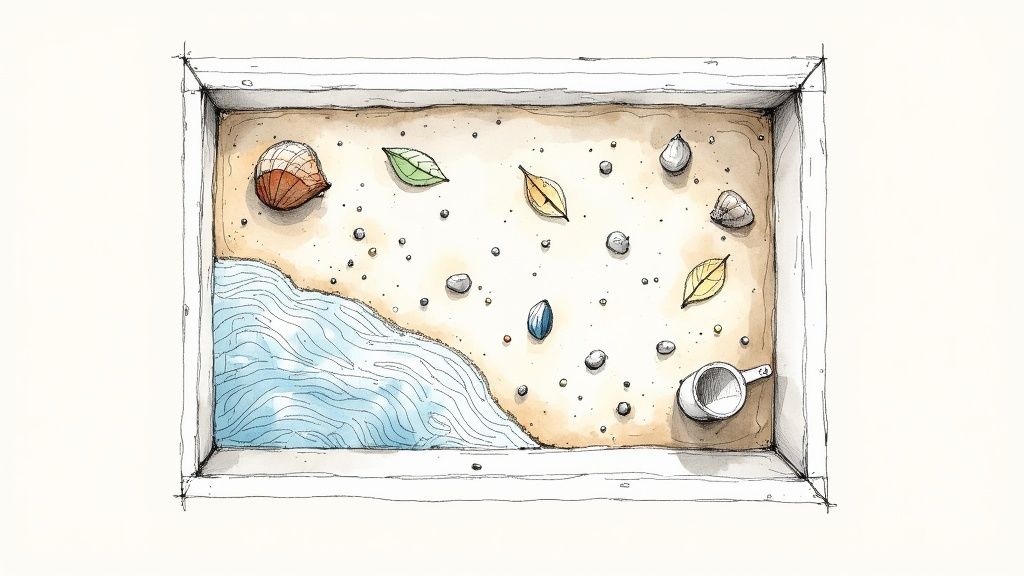
This approach is one of the most effective age-appropriate activities for preschoolers because it supports holistic development. It enhances fine motor skills as children scoop sand or pinch leaves, builds cognitive skills through sorting and categorizing, and fosters scientific thinking as they observe how water moves or rocks sink. For a deeper dive into setting up engaging play areas, you can explore more about creating the perfect play environment on hiccapop.com.
How to Implement Natural Sensory Play
Materials Needed:
- A shallow bin, tray, or water table
- Natural elements: sand, water, smooth stones, leaves, twigs, shells, pinecones, or mud
- Tools: scoops, small buckets, funnels, cups, and brushes
Step-by-Step Instructions:
- Select a Base: Fill your bin with a primary material like sand, water, or soil.
- Add Natural Items: Introduce a variety of contrasting textures. Combine smooth river stones with rough bark, or soft moss with prickly pinecones.
- Provide Simple Tools: Offer tools that encourage scooping, pouring, and transferring. This helps develop hand-eye coordination and fine motor control.
- Facilitate, Don't Direct: Allow your child to lead the exploration. You can ask open-ended questions like, "How does that rock feel?" or "What happens when you pour water on the sand?"
Pro-Tip: Rotate the materials in your sensory bin every week or two to reignite your preschooler's curiosity and introduce new concepts. A "forest floor" bin one week can become a "sandy beach" the next.
Safety First: Always supervise sensory play, especially with small items like pebbles or shells that could be a choking hazard. Ensure all natural materials are clean and free from pests or sharp edges.
2. Finger Painting and Creative Art
Finger painting and other hands-on art projects are cornerstone creative activities for preschoolers, allowing them to express themselves without words. This tactile experience involves using fingers, brushes, and a variety of materials to create visual art, providing a direct connection between a child's imagination and the physical world. It's a foundational activity that builds self-expression, color recognition, and artistic confidence.
This type of open-ended creation is one of the most beneficial age-appropriate activities for preschoolers because it nurtures multiple developmental areas at once. The act of spreading paint with fingers strengthens hand and finger muscles, which is crucial for developing the fine motor control needed for writing later on. Educational approaches like the Reggio Emilia philosophy emphasize these art experiences, viewing them as a vital "language" for children to communicate their thoughts and feelings.
How to Implement Creative Art Time
Materials Needed:
- Non-toxic, washable finger paints or tempera paints
- Large sheets of paper, cardboard, or a washable tabletop surface
- An apron, smock, or old clothing to protect from messes
- Optional creative tools: sponges, cotton balls, leaves, feathers, or rollers
Step-by-Step Instructions:
- Set Up a Mess-Friendly Zone: Lay down newspaper or a plastic tablecloth. Have your child wear a smock or clothes you don't mind getting messy.
- Prepare the "Canvas": Secure a large piece of paper to the table or floor with tape. This prevents it from sliding around and frustrating your little artist.
- Offer the Paints: Squeeze small amounts of a few primary colors onto a paper plate or directly onto the paper. This allows for color mixing exploration.
- Encourage Free Expression: Let your child lead the way. They can use their fingers, hands, or even feet to create. The focus should be on the process, not the final product.
Pro-Tip: Instead of asking "What are you making?", try commenting on their actions to encourage creative thinking. Say things like, "I see you are making big, swirly red lines!" or "You are mixing the blue and yellow to make green."
Safety First: Always use art supplies that are specifically labeled as non-toxic and child-safe. Supervise the activity to ensure children don't put paint in their mouths and to help with cleanup when they are finished.
3. Storytime and Read-Aloud Sessions
Storytime is more than just reading words on a page; it's a dynamic, interactive experience that builds a foundation for lifelong literacy. Reading aloud to preschoolers involves bringing stories to life through expressive voices, engaging questions, and shared discovery. This practice opens up new worlds, introduces complex emotions, and helps children make sense of their own experiences through characters and narratives.
This activity is one of the most essential age-appropriate activities for preschoolers because it directly supports language development, listening comprehension, and emotional intelligence. As children listen to rhythmic text and follow a plot, they are building critical pre-reading skills like phonological awareness and print motivation. Research from organizations like the American Academy of Pediatrics highlights how reading aloud from birth is a key factor in school readiness and long-term academic success.
How to Implement Engaging Read-Aloud Sessions
Materials Needed:
- A selection of age-appropriate picture books
- A comfortable, distraction-free space (a cozy corner, couch, or bed)
- Optional: props like puppets or stuffed animals that match the story's characters
Step-by-Step Instructions:
- Create a Reading Ritual: Designate a consistent time for reading, such as before naps or bedtime. This creates a comforting and predictable routine.
- Let Your Child Choose: Whenever possible, allow your preschooler to select the book. This gives them a sense of ownership and increases their engagement.
- Read with Expression: Use different voices for characters, vary your volume, and change your pace to match the story's mood. Don't be afraid to be silly or dramatic.
- Encourage Interaction: Pause to ask open-ended questions like, "What do you think will happen next?" or "How do you think the bear is feeling?" Let them point to pictures and talk about what they see.
Pro-Tip: Don't shy away from repetition. When your child asks for the same book for the tenth time, they are mastering vocabulary, rhythm, and story structure. This familiarity builds confidence and deepens their comprehension.
Safety First: Choose sturdy board books for younger preschoolers who may be rough with pages. Ensure any sensory books with small, attached parts are used under supervision to prevent choking hazards.
4. Block Building and Construction Play
Block building is a classic preschool activity that involves stacking, arranging, and connecting various materials to create structures. More than just simple play, it’s a powerful tool for developing spatial reasoning, problem-solving skills, and creativity. This type of construction play allows children to experiment with balance, symmetry, and design in a hands-on, tangible way.
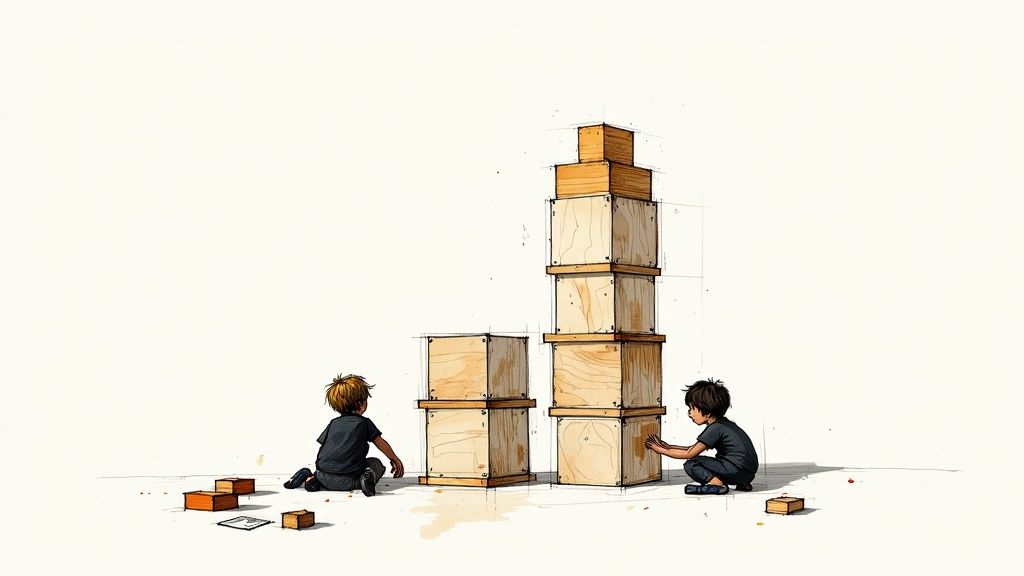
This method is one of the most fundamental age-appropriate activities for preschoolers because it nurtures both cognitive and motor development. As children carefully place blocks, they refine their fine motor skills and hand-eye coordination. They also engage in early mathematical concepts like counting, sorting, and understanding geometric shapes. Furthermore, collaborative building projects teach essential social skills like communication, sharing, and teamwork.
How to Implement Block Building and Construction Play
Materials Needed:
- A set of blocks (wooden unit blocks, plastic interlocking blocks like DUPLO, or large cardboard blocks)
- A designated play area, like a rug or mat
- Optional additions: small figurines, toy vehicles, or natural elements like twigs and stones
Step-by-Step Instructions:
- Set Up an Inviting Space: Designate a clear, flat area for building. Using a specific rug or mat can help contain the blocks and define the construction zone.
- Offer a Variety of Blocks: Provide a mix of shapes, sizes, and types of blocks. Start with larger, simpler blocks for younger preschoolers and introduce more complex sets as they grow.
- Encourage Free Exploration: Let your child take the lead. They might stack, line up, or sort the blocks before they begin building complex structures.
- Engage with Questions: Prompt creative thinking by asking open-ended questions. Try asking, "What are you building?" or "How high can you make your tower before it wobbles?"
Pro-Tip: Keep pictures of real-world buildings like bridges, castles, and skyscrapers nearby to inspire new creations. Allowing a child’s impressive structures to stay up for a day or two can also validate their effort and encourage more elaborate projects.
Safety First: Regularly inspect blocks for splinters, sharp edges, or broken pieces. With smaller interlocking blocks, always supervise to prevent them from becoming a choking hazard, especially in a mixed-age environment.
5. Outdoor Nature Exploration and Hiking
Outdoor nature exploration encourages preschoolers to engage directly with the environment, fostering a sense of wonder and curiosity. This involves guided or unstructured time in natural settings, where children can observe plants, wildlife, and weather phenomena up close. These experiences are fundamental for physical and cognitive development, building resilience and an early appreciation for the natural world.
This type of outing is one of the most enriching age-appropriate activities for preschoolers because it combines physical exercise with scientific discovery. Navigating uneven trails develops gross motor skills and balance, while spotting a beetle or a unique flower sparks early life-science interest. For more ideas on planning your next family outing, you can find inspiration for family-friendly adventures on hiccapop.com.
How to Implement Nature Exploration
Materials Needed:
- Weather-appropriate clothing and sturdy shoes
- A small backpack for your child
- A magnifying glass, bug net, or binoculars
- A sketchbook and crayons for nature journaling
- Snacks and water
Step-by-Step Instructions:
- Choose a Kid-Friendly Location: Start with a short, familiar trail at a local park or nature preserve. Look for paths that are relatively flat and offer interesting features like a creek or large rocks.
- Equip Your Little Explorer: Give your child a tool like a magnifying glass to empower them to investigate. This simple item can turn a regular walk into a scientific expedition.
- Hike at Their Pace: Let your preschooler set the speed. The goal is exploration, not distance. Stop frequently to examine leaves, watch ants, or listen to bird calls.
- Engage the Senses: Encourage your child to describe what they see, hear, and smell. Ask questions like, "What does the tree bark feel like?" or "Can you find something that is the color green?"
Pro-Tip: Revisit the same trail in different seasons. This helps preschoolers observe and understand concepts like seasonal change, plant life cycles, and animal behavior in a tangible way.
Safety First: Always check the weather before you go and dress in layers. Teach your child basic outdoor safety rules, such as staying on the path and not touching unknown plants or animals. Supervise closely, especially near water or uneven terrain.
6. Music and Movement Activities
Music and movement activities combine rhythm, sound, and physical action into a joyful learning experience for preschoolers. This multimodal approach involves singing, dancing, playing simple instruments, and engaging in rhythmic games to create a dynamic environment where children can express themselves freely. It’s a powerful way to connect the body and mind, helping children develop crucial skills in a fun, pressure-free setting.
This combination is one of the most effective age-appropriate activities for preschoolers because it nurtures whole-child development. It enhances gross motor skills through dancing and jumping, improves listening skills as children follow a beat, and boosts language development through singing and chanting. For more specific ideas to get your little ones grooving and developing through sound and motion, explore these 8 fun music and movement activities for preschoolers.
How to Implement Music and Movement
Materials Needed:
- A music player or speaker
- A selection of music with varying tempos and genres
- Simple instruments: maracas, tambourines, drums, or DIY shakers (e.g., rice in a sealed container)
- Optional props: colorful scarves, ribbons, or beanbags
Step-by-Step Instructions:
- Choose Your Music: Start with simple, repetitive songs that preschoolers know and love, like "Wheels on the Bus" or "Head, Shoulders, Knees, and Toes."
- Introduce Instruments: Hand out simple percussion instruments and encourage children to play along with the music. Let them explore making loud, soft, fast, and slow sounds.
- Encourage Free Movement: Play a song and invite your child to move their body however the music makes them feel. There is no right or wrong way to dance. Add props like scarves to inspire creative movement.
- Play a Game: Introduce a classic game like "Freeze Dance." Play music and have everyone dance, then stop the music suddenly. Everyone must freeze in their position until the music starts again.
Pro-Tip: Combine music with storytelling. Act out a story using sounds and movements, like stomping like a giant or fluttering like a butterfly, to make narrative concepts more tangible and exciting.
Safety First: Ensure the play area is clear of obstacles to prevent trips and falls during energetic dancing. Supervise the use of any instruments, especially DIY ones, to ensure they remain safely sealed and are not a choking hazard.
7. Dramatic Play and Role-Playing
Dramatic play involves imaginative activities where preschoolers take on different roles and act out scenarios. Whether pretending to be a doctor, a chef, or an astronaut, children use this symbolic play to make sense of the world, practice social interactions, and explore complex emotions in a safe environment. This form of play is essential for developing language, empathy, and problem-solving skills.
This is one of the most powerful age-appropriate activities for preschoolers because it fosters crucial life skills. It builds vocabulary as they adopt new personas, enhances social skills through negotiation and cooperation, and develops emotional intelligence as they explore different perspectives. Theories from educators like Lev Vygotsky emphasize how such play helps children operate at their highest level of thinking.
How to Implement Dramatic Play
Materials Needed:
- A designated play area or "stage"
- Costumes and props: hats, scarves, old clothes, bags, toy tools (doctor kit, kitchen utensils)
- Open-ended items: cardboard boxes, fabric scraps, blocks, and craft supplies
- Puppets and a simple puppet theater
Step-by-Step Instructions:
- Set the Scene: Create an inviting space. A corner can become a grocery store with empty food boxes, a play kitchen, or a post office with envelopes and stamps.
- Offer Props and Costumes: Provide a collection of items that can spark imagination. Keep them organized in labeled bins so children can easily access and put them away.
- Introduce a Scenario (If Needed): If children are hesitant, you can model play by suggesting a theme. For example, "Let's pretend we're on an adventure in the jungle! What do we need to pack?"
- Let Them Lead: The most important step is to step back and allow children to direct the narrative. Observe their interactions and facilitate only when necessary to help them solve a problem or expand on their ideas.
Pro-Tip: Rotate the themes and props in your dramatic play area every few weeks. A veterinary clinic one month can transform into a space station the next, keeping the play fresh, engaging, and aligned with your child's evolving interests.
Safety First: Ensure all props and costumes are child-safe. Avoid items with small, detachable parts that could be choking hazards, and check for sharp edges on homemade props like cardboard boxes. Supervise play to ensure interactions remain positive and safe.
8. Cooking and Food Preparation Activities
Inviting preschoolers into the kitchen for simple cooking and food preparation is more than just a way to get a meal ready; it's a multi-sensory learning experience. These activities tap into a child's natural curiosity about food, transforming everyday tasks into powerful lessons in math, science, and practical life skills. By measuring, mixing, and assembling ingredients, children develop a deeper understanding of where food comes from and how it nourishes their bodies.
This hands-on approach is one of the most enriching age-appropriate activities for preschoolers because it builds confidence and fine motor control. Stirring batter, kneading dough, and spooning ingredients require coordination and strength, while following simple steps introduces sequencing and basic math concepts like counting and measurement. For more ideas on how to get kids involved in mealtime, explore how to incorporate your toddler into family dinnertime on hiccapop.com.
How to Implement Cooking Activities
Materials Needed:
- Simple, no-bake recipes (e.g., trail mix, fruit salad, smoothies)
- Child-safe utensils like plastic knives, mixing bowls, and measuring cups
- Pre-washed and pre-chopped ingredients (as needed for safety)
- An apron and a stable step-stool
- Picture-based recipe cards
Step-by-Step Instructions:
- Choose a Simple Recipe: Start with something that doesn't require heat, like making a fruit smoothie or assembling personal pizzas on pre-made crusts.
- Prepare the Workspace: Set up a clean, accessible station with all ingredients and tools ready. Ensure your child can comfortably reach the counter with a stool.
- Demonstrate and Guide: Show your preschooler each step, such as how to measure flour or pour milk. Use clear, simple language.
- Encourage Sensory Exploration: Let them touch the sticky dough, smell the vanilla, and taste the safe ingredients. Ask questions like, "What does the cinnamon smell like?" or "How does the flour feel?"
Pro-Tip: Focus on the process, not the product. Spills and messes are part of the learning experience. Celebrate their effort and give them a sense of ownership by letting them serve their creation to the family.
Safety First: Always supervise kitchen activities closely. Teach the importance of handwashing before and after handling food. Ensure all tools are child-safe and keep children away from hot stoves, ovens, and sharp knives. Be mindful of any food allergies.
9. Puzzle and Matching Games
Puzzles and matching games are classic structured activities that play a critical role in a preschooler's cognitive development. These games challenge children to use logic, visual discrimination, and problem-solving skills to recognize patterns, shapes, and relationships. From simple chunky puzzles to more complex memory games, these activities build a strong foundation for future math and literacy skills.
This category of age-appropriate activities for preschoolers is invaluable for developing concentration and persistence. As children work to fit a piece or find a matching pair, they are honing their fine motor skills and hand-eye coordination. For specific recommendations and to understand the developmental benefits of these cognitive challenges, you can explore comprehensive guides on the best puzzles for 4 year olds.
How to Implement Puzzle and Matching Games
Materials Needed:
- Age-appropriate puzzles (e.g., chunky knob puzzles, 4-12 piece jigsaw puzzles)
- Memory or matching card sets
- Shape sorters or color-matching toys
- A clear, flat surface to work on
Step-by-Step Instructions:
- Start Simple: Introduce puzzles with just a few large, distinct pieces, such as a 2-4 piece chunky puzzle. This helps build confidence and prevents frustration.
- Model, Don't Solve: Show your preschooler how to look at the shapes of the empty spaces and the puzzle pieces. You can talk through your process: "This piece looks like it has a round edge, let's look for a round spot."
- Introduce Matching Games: Begin with a memory game where all cards are face up, simply matching pairs. As they master this, you can flip them over for a true memory challenge.
- Create a System: Use trays or designated containers to keep puzzle pieces organized and prevent them from getting lost, making cleanup part of the activity.
Pro-Tip: Celebrate the effort, not just the completion. Praise your child's persistence with phrases like, "I see you are working so hard to find where that piece goes!" This fosters a growth mindset and a love for challenges.
Safety First: Regularly inspect wooden or cardboard puzzles for splintering or worn-out pieces that could break off. For children who still mouth objects, ensure all puzzle pieces and game cards are large enough to not pose a choking hazard.
10. Water Play and Aquatic Exploration
Water play is an immensely engaging sensory activity that allows preschoolers to explore the properties of liquids in a hands-on, unstructured way. It involves pouring, splashing, and experimenting with how objects interact with water, offering a blend of scientific discovery and therapeutic calm. This type of play taps into a child's natural curiosity about their environment, making it a timeless and effective learning tool.
This form of exploration is one of the most versatile age-appropriate activities for preschoolers because it seamlessly combines sensory input with foundational STEM concepts. It strengthens fine motor skills as children use tools like cups and sponges, introduces scientific principles like buoyancy and volume, and provides a calming experience that can help regulate emotions. Water play is accessible, requiring minimal setup for maximum engagement and learning.
How to Implement Water Play
Materials Needed:
- A water table, large plastic tub, or even the bathtub
- Water (warm water is often more comfortable for extended play)
- Tools: cups, funnels, strainers, sponges, small watering cans, and droppers
- Floating/sinking objects: plastic toys, corks, smooth stones, toy boats, or leaves
Step-by-Step Instructions:
- Set Up the Area: Fill your container with a few inches of water. Place a towel underneath to manage splashes and spills.
- Introduce Tools: Add a variety of pouring and scooping tools. Include items with holes, like a colander, to show how water can flow through things.
- Add Test Objects: Provide a mix of items that will float and sink. This encourages experimentation and prediction-making.
- Encourage Exploration: Let your child lead the activity. You can model curiosity by asking questions like, "I wonder what will happen if we put the rock in the boat?" or "Which cup holds more water?"
Pro-Tip: Add a few drops of non-toxic food coloring to the water or some bubble bath to create a new sensory dimension. This simple addition can completely refresh the activity and spark new interest.
Safety First: Never leave a child unattended during water play, regardless of the water's depth. Ensure the play area is on a stable, flat surface to prevent tipping, and always empty the container immediately after use.
Age-Appropriate Preschool Activities: 10-Item Comparison
| Activity | 🔄 Implementation complexity | ⚡ Resource requirements | ⭐📊 Expected outcomes | Ideal use cases | 💡 Key advantages / Tips |
|---|---|---|---|---|---|
| Sensory Play with Natural Materials | Low–Moderate: easy setup; requires supervision | ⚡ Low: natural items, trays, outdoor/indoor space | ⭐⭐⭐⭐📊 Improves sensory processing, fine motor skills, calming effect | Open-ended play, calming corners, outdoor exploration | Rotate textures; use non-toxic items; supervise small pieces |
| Finger Painting and Creative Art | Low: minimal instruction; messy management needed | ⚡ Low: washable paints, paper, aprons, ventilation | ⭐⭐⭐⭐📊 Boosts fine motor control, creativity, color recognition | Art centers, free-expression sessions, sensory art time | Use washable, non-toxic paints; protect clothing; display work |
| Storytime and Read-Aloud Sessions | Low: planning time for book selection; caregiver commitment | ⚡ Very low: books, cozy space, optional props | ⭐⭐⭐⭐⭐📊 Strong language, vocabulary, listening and pre-literacy gains | Circle time, bedtime routines, library story hours | Use rhythmic texts; vary voices; ask predictive questions |
| Block Building and Construction Play | Moderate: requires space and organization | ⚡ Moderate: blocks/sets, mats, storage | ⭐⭐⭐⭐📊 Builds spatial reasoning, problem-solving, cooperation | STEM corners, collaborative projects, free-build time | Provide varied sizes; keep inspiration photos; define play area |
| Outdoor Nature Exploration and Hiking | Moderate: planning, safety checks, weather-dependent | ⚡ Low–Moderate: outdoor site, journals, magnifiers | ⭐⭐⭐⭐⭐📊 Enhances gross motor skills, environmental awareness, well-being | Park visits, short hikes, forest school sessions | Start short; teach safety; use nature journals and magnifiers |
| Music and Movement Activities | Low–Moderate: space and noise considerations | ⚡ Moderate: instruments, audio, open area | ⭐⭐⭐⭐📊 Improves coordination, language, rhythm, social engagement | Circle time, music classes, energetic breaks | Use simple songs with repetition; provide props (scarves, drums) |
| Dramatic Play and Role-Playing | Moderate: needs props, themed spaces, rotation | ⚡ Moderate: costumes, props, storage space | ⭐⭐⭐⭐📊 Builds social-emotional skills, language, empathy | Dress-up corners, puppet theaters, themed centers | Rotate props; offer diverse costumes; model role-play gently |
| Cooking and Food Preparation Activities | Moderate–High: safety and prep required | ⚡ Moderate: ingredients, child-safe utensils, kitchen area | ⭐⭐⭐⭐📊 Teaches fine motor, early math, life skills, nutrition | No-bake recipes, family cooking time, nutrition lessons | Use simple recipes, pre-prep ingredients; enforce hygiene and allergy checks |
| Puzzle and Matching Games | Low: straightforward setup; maintain pieces | ⚡ Low: puzzles, cards, storage | ⭐⭐⭐⭐📊 Develops problem-solving, concentration, fine motor control | Table activities, quiet time, focused individual play | Start with simple puzzles; organize pieces; praise persistence |
| Water Play and Aquatic Exploration | Low–Moderate: setup and strict supervision | ⚡ Moderate: tubs/tables, towels, warm water | ⭐⭐⭐⭐📊 Teaches scientific concepts, motor skills, calming sensory input | Water tables, bathtub play, sensory stations | Use warm water; provide varied tools; supervise constantly |
Turning Everyday Moments into Playful Learning
As we’ve explored, the world of a preschooler is a vibrant, bustling laboratory for learning, and you are their most important guide and lab partner. This extensive list of age-appropriate activities for preschoolers isn't meant to be a strict to-do list or another source of pressure for busy parents. Instead, view it as a flexible menu of opportunities—a collection of starting points to spark connection, curiosity, and joyful discovery. The true magic lies not in perfectly executing every activity but in adopting a playful mindset.
The journey from sensory play with mud to collaborative cooking in the kitchen is paved with incredible developmental milestones. Each squish of playdough, every carefully stacked block, and each silly character voice during storytime builds crucial neural pathways. These experiences are the very foundation upon which future academic, social, and emotional skills are built. Remember, the goal isn't to create a masterpiece with finger paints or to build the tallest tower; the goal is to embrace the process, celebrate the effort, and honor your child's unique way of exploring their world.
Key Takeaways for Fostering Playful Development
Let's distill the core principles woven throughout these activities into actionable takeaways you can implement today:
- Follow Their Lead: The most engaging activities are often the ones initiated by your child's own curiosity. If they are fascinated by a ladybug during a nature walk, lean into it. That moment is a richer learning opportunity than any pre-planned activity they aren’t interested in.
- Process Over Product: Focus on the "doing" rather than the finished result. The learning in dramatic play happens during the negotiation of roles, not in the final "performance." The fine motor skills from painting are developed with each brushstroke, regardless of what the final picture looks like.
- Embrace the Mess: Meaningful, hands-on learning is rarely tidy. From water play splashes to flour-dusted counters, mess is often a sign of deep engagement. Planning for it with smocks, splash mats, or outdoor settings can lower your stress and increase their freedom to explore.
- Adapt and Simplify: You don't need a craft store's worth of supplies. The best age-appropriate activities for preschoolers often use what you already have. A cardboard box can be a rocket ship, a set of measuring cups can be a lesson in volume during bathtime, and a simple walk can be a scientific expedition.
Weaving Play into Your Daily Rhythm
Integrating these concepts doesn't require a complete overhaul of your schedule. It’s about recognizing and seizing the small, teachable moments that pop up throughout the day. Narrate what you’re doing as you fold laundry, turning it into a vocabulary lesson about colors and textures. Involve your preschooler in simple meal prep, like tearing lettuce or stirring batter, to build practical life skills and a sense of contribution. Transform a car ride into a game of "I Spy" to sharpen observation and language skills.
By consistently providing these rich, varied, and hands-on experiences, you are giving your child an incredible gift. You are nurturing their innate creativity, strengthening their problem-solving abilities, and building a secure, loving bond that will serve as their anchor. You are teaching them that learning isn't a chore confined to a classroom; it's a joyful, lifelong adventure. The foundation you lay during these precious preschool years through simple, intentional play will support their growth and success for many years to come.
For those moments when you need a safe, contained space for quiet activities, puzzles, or sensory bins, Hiccapop has you covered. Our versatile playpens and booster seats create the perfect, secure spot for your little one to explore, making it easier to manage playtime at home or on the go. Discover how our thoughtfully designed products can support your child's developmental journey at Hiccapop.