


Car Seat Installation Tips for Confident Parents
When it comes to your child's safety, correctly installing their car seat is one of the most important things you can do. A top-of-the-line car seat offers zero extra protection if it isn't properly secured in your vehicle. But don't worry—once you master a few key principles, you'll feel confident that your child is as safe as possible on every single ride.
Why Proper Car Seat Installation Matters Most
Let's start with a reality check every parent needs to hear: a car seat is only as good as its installation. You could have the most expensive, feature-packed seat on the market, but if it’s loose or used incorrectly, it simply can’t do its job in a crash.
I get it. The process can feel intimidating with all those straps, clips, and confusing diagrams. It’s easy to feel uncertain, but my goal here is to help turn that doubt into complete confidence. We'll reframe installation from a daunting chore into the most impactful safety action you can take for your child.
The Sobering Statistics
Here’s a number that stops most parents in their tracks: a staggering 46% of car seats are misused in a way that could reduce their effectiveness, according to the National Highway Traffic Safety Administration (NHTSA). That's nearly half of the children riding in car seats who aren't getting the full protection they were designed for.
This isn’t meant to scare you; it’s meant to empower you. Knowing the common pitfalls is the first step toward avoiding them. The most frequent mistakes I see include:
- Loose Installation: The car seat moves more than one inch side-to-side or front-to-back when you tug it at the belt path.
- Loose Harness Straps: You can pinch a horizontal fold in the strap at your child's collarbone. The straps should be snug.
- Incorrect Recline Angle: For infants, a seat that’s too upright can cause their head to flop forward, potentially blocking their airway. This is a critical check for newborns.
- Improper Use of LATCH or Seat Belts: A common error is using both systems at the same time when the seat's manual doesn't permit it, or forgetting to lock the vehicle’s seat belt.
Moving From Uncertainty to Confidence
Proper car seat installation is a critical piece of the puzzle, aligning with broader overall traffic safety initiatives. This is a tangible skill, and you can absolutely master it.
The goal isn’t just to get the car seat in the car; it’s to make it a seamless, secure part of the car. Think of it as creating a protective shell for your child that absorbs and distributes crash forces effectively.
My goal is to help you move beyond just following steps to truly understanding the why behind each action. When you know why that recline angle is vital for an infant's airway or why a rock-solid installation is non-negotiable, the process becomes intuitive. You'll learn to trust your own checks and feel assured every time you buckle your little one in.
Getting Ready for a Safe and Secure Install
Before you even try to get that car seat into your vehicle, a little prep work goes a long way. Trust me, spending a few minutes on this now can save you a ton of frustration later. Think of it as your pre-flight check.
The golden rule, and I can't stress this enough, is to read the manuals.
Yep, both of them. Your car seat manual and your vehicle’s owner’s manual are your definitive guides for a secure installation. They have specific instructions for your exact seat and car that no general advice (not even this guide!) can replace.
Get to Know Your Car Seat
First things first, get familiar with the car seat itself. The best place to do this is in your living room, not crammed in the back of your car. Unbox it, play with the features, and figure out how everything works without the pressure of having to go somewhere.
You’ll want to spot a few key components right away:
- Belt Paths: These are the dedicated slots for routing the vehicle seat belt or LATCH strap. They're almost always color-coded to prevent mistakes: blue for rear-facing and orange or red for forward-facing. Using the wrong one is a serious, but common, error.
- Recline Indicators: Most infant and convertible seats have a level line, bubble, or dial. This little gadget is non-negotiable for newborns, as the right angle keeps their airway open and clear.
- Lock-Offs: Some seats have a built-in device that clamps the seat belt down tight, which can make getting a secure fit much easier. Your manual will show you if you have one and how it works.
- Harness Adjuster: Find the strap and button that loosens and tightens the harness your child wears. You'll be using this every single time you put your little one in the car.
Figuring all this out beforehand is a game-changer. It sets you up for a smooth and confident installation.
Beyond just the installation, it's also your responsibility to know the A-to-Z of car seat safety. This includes things like knowing your car seat expiration dates, because the plastic degrades over time and safety standards are constantly improving.
Scout Out Your Vehicle
Next up, it’s time to investigate your car. Grab that vehicle owner’s manual (the one you probably haven't opened since you bought the car) and flip to the section on "Child Restraints" or "Child Safety."
Here’s what you’re looking for:
- Find Your LATCH Anchors: Pinpoint the exact locations of the lower anchors—the small metal bars tucked into the vehicle seat cushion—and the top tether anchor. Not every seating position has them.
- Check Middle Seat Rules: Your manual will tell you if you're allowed to install a car seat in the middle using the innermost LATCH anchors from the side seats (often called "LATCH borrowing"). Spoiler alert: most vehicle manufacturers do not allow this.
- Learn How to Lock the Seat Belt: If you're using the seat belt instead of LATCH, you must lock it to keep the car seat from shifting. In most cars made after 1996, you can do this by slowly pulling the shoulder belt all the way out until you hear a click, then letting it feed back in. It will stay locked tight.
Think of it this way: your car seat and your vehicle are two halves of a critical safety system. For it to work, they have to communicate perfectly. The manuals are your translation guides. Taking 20 minutes for this prep work will give you the confidence that you’re starting off right.
Installing Your Rear-Facing Car Seat Correctly
Alright, let's get that car seat installed. Putting in a rear-facing seat is one of the most important things you'll do to protect your little one. Keeping them rear-facing as long as possible is the gold standard in car seat safety, plain and simple. It gives the best support for their head, neck, and spine if a crash happens.
We’ll walk through the two ways to do this: using the LATCH system or your car's seat belt.
A crucial point right off the bat: you'll use either the LATCH system or the seat belt—almost never both at the same time. Your car seat manual is your bible here, but using both can actually interfere with how the seat is designed to work in a collision. One method isn't safer than the other; the safest installation is the one you can do correctly and confidently every single time.
Nailing the LATCH Installation
The LATCH system (which stands for Lower Anchors and Tethers for Children) was created to make installing car seats a bit more straightforward. Instead of wrestling with a seat belt, you use anchors built right into your car.
First things first, find the lower anchors in your vehicle's back seat. They’re small metal bars tucked into the crack where the seat back and bottom cushion meet. Your car's owner's manual will have a diagram showing you exactly where to look. Now, grab the LATCH connectors on your car seat (they're on flexible straps) and clip them onto the anchors. You should hear a solid click that tells you they're locked on.
Now comes the part where a little technique makes a huge difference: getting it tight.
Pro Tip: Don't just yank on the tightening strap. Put one knee into the car seat and use your body weight to press it firmly down and back into the vehicle seat. While you're applying that pressure, pull the LATCH strap until there's no slack left. This trick is a game-changer for getting a super-snug fit.
Once you think you have it, do the "one-inch test." Grab the car seat at the belt path (where the LATCH strap feeds through it) and give it a good tug side-to-side and front-to-back. It shouldn't move more than one inch in any direction. If it does, you'll need to tighten it more.
Mastering the Seat Belt Installation
If your car doesn't have LATCH anchors in the spot you want to use (like the middle seat in many vehicles), or if you just find the seat belt easier, this method is every bit as safe when you do it right.
Start by threading the vehicle’s seat belt through the correct rear-facing belt path. On most seats, this path is helpfully color-coded blue. This is a critical detail—using the forward-facing path (often red or orange) is a very dangerous mistake.
After you buckle the seat belt, you have to lock it. On most cars made after 1996, you do this by slowly pulling the shoulder belt all the way out until it starts making a clicking or ratcheting sound. Then, as you feed it back in, it will be locked tight. This keeps the car seat from coming loose over time.
Just like with the LATCH method, use your body weight to press down on the car seat while you pull the shoulder belt tight to get all the slack out. Some car seats have a built-in "lock-off" device to clamp the belt for you, which makes things even easier. Check your manual to see if yours has one and how to use it.
This infographic breaks down the crucial prep work you need to do before you even start.
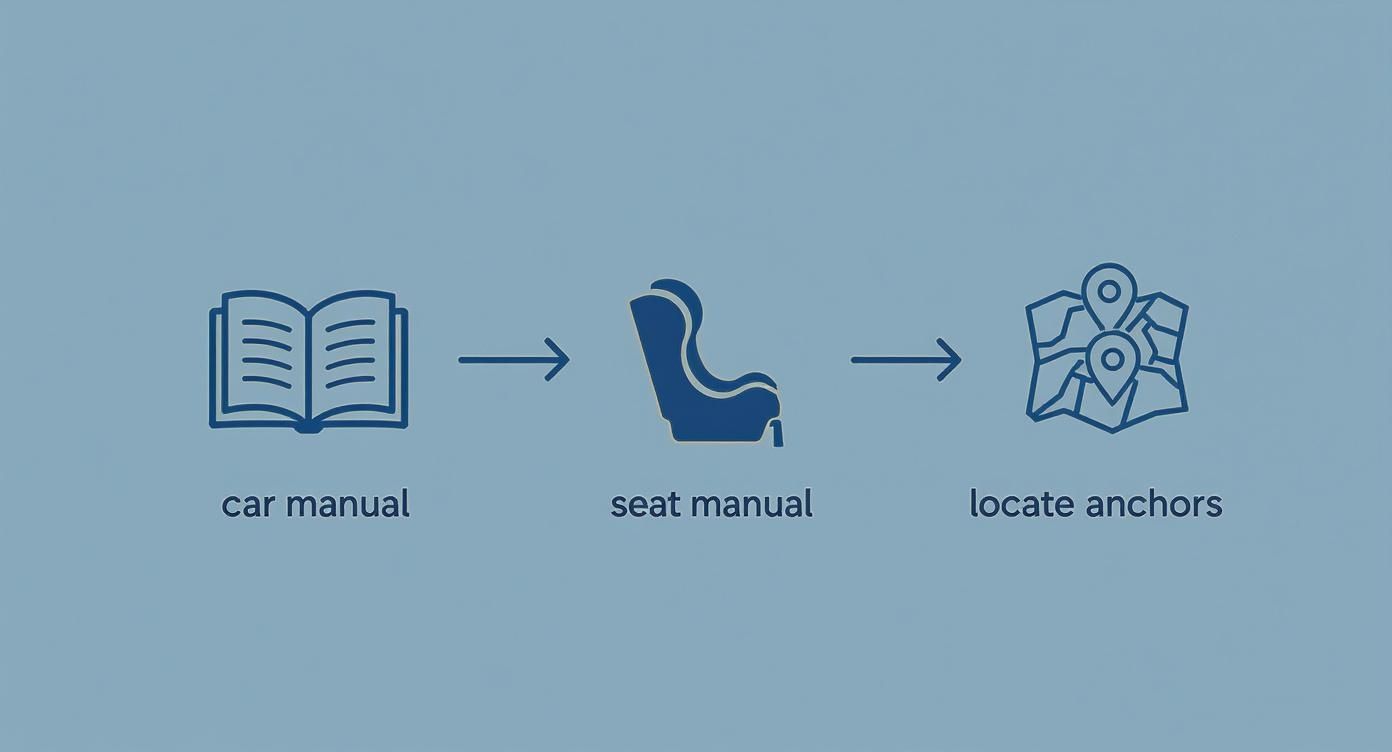
It’s a great reminder that reading your manuals and finding all the right parts are non-negotiable first steps for a safe installation.
Getting the Recline Angle Just Right
For newborns and young infants, the recline angle isn't just about comfort—it's a critical safety feature. A baby's neck muscles are weak, and if the seat is too upright, their head can slump forward and block their airway. This is precisely why rear-facing seats are designed to recline.
Look for a recline indicator on the side of your car seat. It could be a bubble level, a colored dial, or a simple line on a sticker.
- For infants without head control: The indicator must be in the designated newborn range. This is the most reclined position.
- For older babies and toddlers: As they get stronger, you can usually make the seat a bit more upright. This often buys you a little more legroom in the front seat, too.
Your car seat manual will tell you exactly what angle is right for your child’s age and size. Always double-check this indicator after the seat is fully installed and tightened, because the installation process itself can sometimes change the angle slightly. If you're having trouble getting it right, some manufacturers allow you to place a tightly rolled towel or a pool noodle under the base of the seat to help. But you must confirm this is okay in your car seat's manual first—never just assume.
Getting this angle right, along with knowing how long your child should remain rear-facing, are two of the most powerful things you can do to keep them safe on every trip.
Navigating Forward-Facing and Booster Seat Setups
As your child grows, their car seat needs will change, and it often feels like these milestones are flying by. One minute you're bringing home a tiny infant, and the next, you're wondering if it's time to turn their car seat around. Let’s walk through the next two critical stages: transitioning to a forward-facing seat and, eventually, graduating to a booster.
Child passenger safety is a serious business. In 2023, the global child safety seat market was valued at an incredible USD 4.4 billion, with North America and Europe really setting the bar for safety standards. Federal laws across the U.S. require children to be properly restrained, and for good reason. You can dive deeper into the global child safety seat market and its trends to see just how much focus is placed on protecting our kids.
When to Make the Switch to Forward-Facing
One of the most frequent questions I get from parents is, "When can I finally turn my toddler's car seat around?" The safest, most straightforward answer is this: wait as long as you possibly can. I know it's tempting to switch them to forward-facing on their second birthday, but that's a minimum, not a best practice.
The golden rule is to max out the limits of your convertible seat in its rear-facing position. Every seat has specific height and weight limits listed in the manual—stick to them. A child’s head, neck, and spine are immeasurably better protected in a rear-facing seat during a collision. Keeping them rear-facing until they physically outgrow the seat is one of the most impactful safety decisions you can make.
The Most Important Step You Might Miss
When you do turn that seat around, there's one step that is absolutely non-negotiable but is shockingly easy to forget: using the top tether.
So, what is it? The top tether is a long strap with a hook on the end that extends from the top of the car seat. This hook is designed to connect to a dedicated tether anchor point in your vehicle.
And why is it so vital? In a crash, the top tether dramatically limits how far your child's head can whip forward. Safety experts estimate it can reduce forward head movement by a staggering 4 to 6 inches. That reduction is huge when it comes to preventing serious head and neck injuries.
Think of the top tether as a brake for your child's head. Without it, the car seat can pivot forward violently in a frontal collision. With it, the seat stays much more stable, protecting your child's delicate neck and spine from extreme forces.
Finding the anchor in your car is usually pretty simple once you know what to look for. Your vehicle's owner's manual will have a diagram, but they are typically located on the back of the vehicle seat, on the rear shelf behind the headrests, or even on the ceiling in some SUVs and minivans. Just look for a small symbol of a car seat with an anchor behind it.
Graduating to a Booster Seat
Moving to a booster seat is another huge milestone, but it requires a mental shift. With a booster, you're no longer installing the seat itself; you're simply positioning the child so that the vehicle's own seat belt fits them correctly.
The entire purpose of a booster seat—whether it's a high-back or a backless model—is to lift your child up so the car's built-in safety system can do its job. A proper belt fit is everything.
Here’s your two-point check for every single ride:
- The Lap Belt: It must lie low and snug across your child's upper thighs and strong hip bones. It should never ride up onto their soft belly, where it could cause severe organ damage in a crash.
- The Shoulder Belt: It should cross right over the center of their collarbone and chest. It shouldn't be cutting into their neck or constantly slipping off their shoulder.
The transition to a booster is a big step toward independence, but it’s critical not to rush it. A child needs to be not only big enough but also mature enough to sit properly for the entire ride—no slouching, leaning over, or tucking the shoulder belt behind their back. Knowing when your child is truly ready for a booster seat is about observing these developmental cues, not just hitting a certain age or weight.
For a quick reference, here’s a checklist you can use to confirm the most important safety steps for each installation method.
Car Seat Installation Checklist At-A-Glance
| Safety Check | Rear-Facing | Forward-Facing | Booster Seat |
|---|---|---|---|
| Location | Back seat only | Back seat only | Back seat only |
| Recline Angle | Follow indicator on the seat | Seat should be upright | Relies on vehicle seat |
| Less Than 1" of Movement? | Yes, check at the belt path | Yes, check at the belt path | N/A (seat rests on vehicle seat) |
| Harness Straps | At or below shoulders | At or above shoulders | N/A (uses vehicle belt) |
| Top Tether Used? | No (not for rear-facing) | Yes, always! | N/A |
| Belt Fit on Child | N/A (uses 5-point harness) | N/A (uses 5-point harness) | Lap belt on thighs, shoulder belt on chest |
This table provides a quick visual rundown, but remember that your car seat and vehicle manuals are your ultimate guides. Always consult them for instructions specific to your products.
Performing Your Final Safety Checks
You’ve wrestled with the manuals, threaded the straps, and put some muscle into tightening everything down. Nice work. But before you call it a day, there are two quick, non-negotiable checks that will tell you if your installation is truly road-ready.
Think of these as the final once-over you'll do before every single trip. They take less than 30 seconds but are your best defense against the most common—and most dangerous—installation errors.
Once these become second nature, you’ll have the confidence that comes from knowing your child is secure, not just hoping they are.
The One-Inch Test for a Rock-Solid Install
First up, let's make sure that car seat isn't going anywhere. A properly installed seat should feel like it’s part of your vehicle's frame. The "one-inch test" is the industry gold standard for checking this.
Here’s what you do: Grab the car seat at the belt path. This is the only place that matters for this test—it's where the seat is connected to the car. Using your non-dominant hand, give it a firm tug side-to-side and front-to-back.
That seat should not move more than one inch in any direction. If it slides or wiggles more than that, it's not tight enough. You'll need to go back and tighten the LATCH belt or the vehicle seat belt, likely using that bodyweight trick we talked about earlier to get it truly snug.
Keep in mind, the top of the seat (especially a tall, rear-facing one) will have some natural movement. Don't let that fool you. All that matters is that it's locked down tight at the belt path.
The Pinch Test for a Snug Harness
Next, it’s all about the harness. A secure installation is only half the battle; the harness straps must be perfectly snug against your child to do their job. In a crash, loose straps are a major hazard and can lead to serious injury.
This is where the "pinch test" comes in. It’s simple and foolproof.
After you've buckled your child in and pulled the harness tight, try to pinch a horizontal fold of the webbing right at their collarbone.
If you can grab a pinch of the strap between your thumb and forefinger, it's too loose. You need to tighten it more. If your fingers just slide right off the webbing, it's perfect.
This quick check takes all the guesswork out of it. A snug harness is what holds your child in place and distributes those heavy crash forces correctly. It's a must-do before you put the car in drive.
Your Final Cheat Sheet of Common Mistakes to Avoid
Even the most careful parents can make mistakes. I've seen them all. Knowing what to look for is the best way to make sure your installation is flawless every time.
Here's a quick rundown of the most common pitfalls I see in the field:
- Forgetting the Top Tether: If your child is in a forward-facing seat, using the top tether is non-negotiable. In a crash, it can reduce how far your child’s head moves forward by up to six inches—a massive factor in preventing serious head and neck injuries. Always find the proper anchor point in your vehicle and hook it up.
- Using the Wrong Belt Path: Those color-coded slots aren't just for decoration. Car seat belt paths are designed for one direction only: blue is for rear-facing, and orange or red is for forward-facing. Running the seat belt or LATCH strap through the wrong path completely undermines the seat's safety.
- Ignoring the Recline Angle: For infants who can't hold their heads up yet, the recline angle is a critical safety feature. A seat that's too upright can cause their head to slump forward, potentially blocking their airway. Always double-check the recline indicator after the seat is fully tightened to ensure it's in the safe zone.
- Turning Forward-Facing Too Soon: I know it’s tempting to turn them around, but keeping your child rear-facing for as long as possible (until they max out the seat's height or weight limits) offers far superior protection for their fragile head, neck, and spine.
- Adding Aftermarket Junk: Those cute strap covers, infant head positioners, or under-seat mats that didn't come with your car seat? Avoid them. These unregulated products can interfere with how the seat performs in a crash. If it didn't come in the box from the manufacturer, it doesn't belong on the seat.
Your Car Seat Installation Questions Answered
If you’ve got a million questions swirling in your head while trying to install a car seat, you’re in good company. I can guarantee another parent is staring at their car's manual at this very moment, wondering the exact same thing. Let's tackle some of the most common puzzles we hear from parents just like you.
Getting clear, expert-backed answers is the key to building real confidence. Let's dive in.
Can I Install a Car Seat in the Middle Seat Using LATCH?
This is easily one of the most frequent points of confusion. We all hear that the middle seat is statistically the safest spot in the car, but here’s the catch: most vehicles do not have dedicated LATCH anchors for that position.
The only way to know for sure is to grab your vehicle's owner's manual. It will tell you, in no uncertain terms, whether you are permitted to "borrow" the innermost lower anchors from the two outer seats. If the manual says no, or if the spacing between those anchors is wider than your car seat manufacturer allows, then the answer is a firm "no."
Don't worry, though. A secure installation using the vehicle's seat belt is the correct—and equally safe—choice for the middle seat in this scenario.
My Car Seat Still Moves a Little. Is That Normal?
A little bit of movement can be totally normal, but it all comes down to where you're checking. The only place to test for tightness is right at the belt path—the exact spot where the LATCH strap or vehicle seat belt threads through the car seat itself.
When you grab the car seat at the belt path and give it a firm tug, it shouldn't move more than one inch side-to-side or front-to-back. The top of the car seat, especially a tall rear-facing one, will naturally have more "play." That's completely expected and not a sign of a bad install. Just focus on getting that rock-solid fit at the base.
A secure car seat should feel like it's part of the vehicle. That one-inch rule at the belt path is your gold standard for knowing you've nailed it.
Where Can I Get My Installation Checked by a Pro?
Getting a second set of expert eyes on your work is a fantastic move, even for veteran parents. Certified Child Passenger Safety Technicians (CPSTs) are trained professionals who can teach you the ropes and spot common mistakes you might have missed.
You can find local CPSTs and car seat check-up events through national organizations like Safe Kids Worldwide, which has a handy search tool on its website. It's also worth checking with your local fire department, police station, or hospital, as many have certified technicians on staff who are happy to help.
Even a perfect home installation can get tricky when you're on the move. For more tips on managing car seats during your adventures, check out our comprehensive guide on traveling with car seats.
At Hiccapop, we believe confident parenting starts with the right tools and knowledge. Our products are designed to make your life a little easier and your child's journey a lot safer. Explore our full range of thoughtfully engineered baby and toddler gear at https://hiccapop.com.